The post Does Chamomile Tea Have Caffeine? appeared first on Sleepopolis.
]]>We know what you’re thinking: “Chamomile tea? But isn’t tea generally caffeinated?”
It’s a viable concern. After all, caffeine is the stuff you drink when you’re trying to avoid sleeping. How could something with caffeine in it promote better sleep?
That’s why we’re diving into the topic today to determine if chamomile tea truly is caffeine-free, as well as explore the many benefits of chamomile tea and how it stacks up against other teas.
You were right to catch that tea, in general, contains caffeine. So, how could chamomile tea make you sleepy when caffeine is a stimulant?
That’s because chamomile tea technically isn’t a tea at all, or at least not a “true tea.”
Let’s break it down — “true teas,” like your everyday green tea, black tea, white tea, etc., come from the Camellia sinensis plant. Camellia sinensis naturally contains caffeine, so when its leaves are plucked, dried, and placed in convenient tea bags for you to steep, you get that caffeinated goodness you crave when you’re busy burning the candle from both ends.

Chamomile tea, made from the matricaria chamomilla or German chamomile plant, is actually a tisane, more commonly referred to as an “herbal infusion.” Herbal teas, including chamomile, peppermint, ginger, hibiscus, and rooibos, are naturally caffeine-free.
That’s why chamomile tea, unlike true teas, promotes relaxation, induces drowsiness, and helps millions of people worldwide settle down when it’s time to go to sleep.
The short answer: No, chamomile tea does not contain caffeine.
Remember, all true teas come from the leaves of the Camellia sinensis plant, which naturally produce caffeine. Thus, when you brew a nice hot cup of jasmine, green, or oolong, the caffeine from the leaves is steeped into your cup and enters your system as you enjoy.
Chamomile flowers do not produce caffeine. Like most herbal teas, chamomile tea is naturally caffeine-free, making it the clear choice when it comes to choosing a proper bedtime beverage.
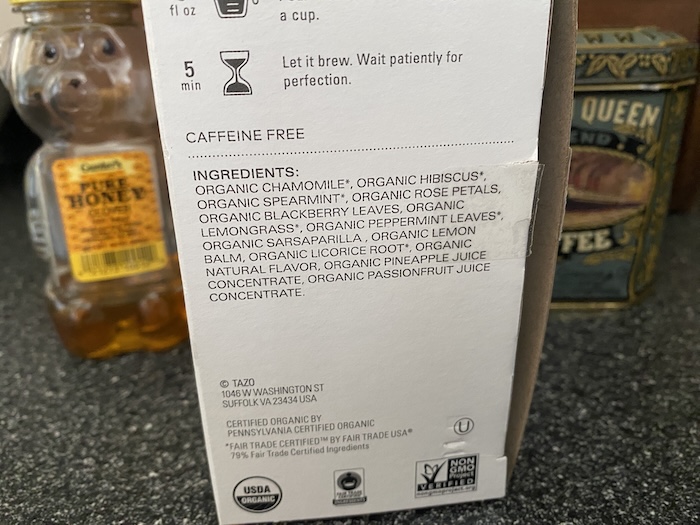
That said, you do want to have an eagle eye when it comes to chamomile tea packaging. Some chamomile tea products are blended with other types of tea, like green tea or black tea, so they contain caffeine.

You’ll want to peruse the packaging for some peace of mind, but chances are that, if what you’re drinking is 100-percent chamomile, then it’s 100-percent caffeine-free too.
You just can’t beat a warm cup of chamomile tea before bed. It’s the perfect thing for setting the mood and helping you ease into a comfy, cozy, sleepy state before drifting off to dreamland.
There are actually many health benefits associated with drinking chamomile tea and/or using chamomile supplements.
The special sauce responsible for chamomile’s trademark sleepytime effect is called apigenin1. Apigenin is an antioxidant that binds to the GABA receptors of your brain in order to produce a mild sedative effect, which may induce a feeling of drowsiness in some users.
A 2024 meta-analysis in Complementary Therapies in Medicine2 reviewed the effectiveness of chamomile as a sleep aid, ultimately concluding that “chamomile improved sleep, especially the number of awakenings after sleep or staying asleep.”

If you generally have trouble falling or staying asleep, we would still recommend discussing the problem with a qualified medical professional. However, drinking chamomile tea before bedtime may work as a non-medical, relatively risk-free way of getting better sleep, so don’t count it out!
Drinking chamomile tea may also help reduce stress and anxiety.
A 2024 review in Clinical Nutrition Research3 explored the “sedative efficacy of chamomile as an herbal medicine for anxiety treatment.” They found that consuming chamomile daily, whether by taking chamomile extract as a supplement or drinking chamomile tea, is “effective in improving anxiety.”
You should always discuss medical symptoms with a doctor first and foremost, but the anxiolytic effects of chamomile coupled with the findings of the above study suggests that having a warm cup of chamomile tea may improve mental health and wellness by reducing stress and anxiety.
Chamomile also exhibits anti-inflammatory properties, so sipping chamomile may soothe a sour stomach and help with uncomfortable gastrointestinal symptoms like gas and bloating.
According to a 2022 review in Molecules4, chamomile may “relieve pain caused by functional digestive disorders,” while a 2023 study in the Journal of Ayurveda and Integrative Medicine5 determined that “chamomile has a potential therapeutic effect on the gastrointestinal and can reduce flatulence.”

That’s not all: A review in Molecular Medicine Reports6 noted that the flavonoids in chamomile also inhibit the growth of Helicobacter pylori, a bacteria that contributes to stomach ulcers. It’s by no means a panacea, but you may combat the growth of stomach ulcers or get relief from ulcer-related pain by drinking chamomile tea regularly.
Chamomile, as a bedtime tea, demolishes traditional teas because it’s naturally caffeine-free. Compare that to the average caffeine content found in one cup of your traditional black, green, and white teas, and it’s no contest:
Other herbal teas, like the minty-fresh peppermint tea, the earthy rooibos tea, or the tart and fruity hibiscus tea, make excellent bedtime choices too because, like chamomile, they’re not “true teas” that come from the Camellia sinensis plant. They’re herbal infusions, so they also contain no caffeine whatsoever.
Most folks don’t have to think twice before buying a box of chamomile tea bags and steeping to their heart’s content, but there are some potential side effects to consider before you ingrain the popular bedtime remedy into your personal routine.
German and Roman chamomile flowers are in the Asteraceae or daisy family, meaning people who are allergic to ragweed, daisies, marigolds, or chrysanthemums may experience an allergic reaction to chamomile too.

If you’ve had sensitivities to any of these plants, check with your doctor or another healthcare professional before drinking chamomile tea or taking chamomile supplements.
A 2024 randomized controlled trial in the Journal of Applied Laboratory Medicine7 observed that chamomile displayed anticoagulant properties, meaning it would take more time for your blood to clot if you had recently or have regularly consumed chamomile.
That’s not inherently bad, but it could be a problem for an individual taking blood thinners to manage an illness or health condition. The trial did note that “the clinical significance of [these properties] is unclear… and warrants further investigation,” but it’s prudent to err on the side of caution and discuss the risks of using chamomile with your doctor just in case.
At a glance, there’s nothing harmful in chamomile, but its safety for children, pregnant women, and those who are breastfeeding hasn’t been firmly established and warrants further study.
In fact, a 2025 review in Cureus8 found that using chamomile products while pregnant may negatively impact “preterm labor/delivery, miscarriage risk, and birth weight and length.” The review also referred to the evidence supporting this conclusion as “weak,” but it’s nonetheless crucial for pregnant individuals to consult their doctors regarding the risks of using chamomile prior to incorporating it into their wellness routines.
We understand there’s an adage about things that are too good to be true.
Chamomile may not be a “true tea,” but it is truly caffeine-free, making it an easy addition to any bedtime routine that needs a certain je ne sais quoi to bring the relaxation to a whole new level. We here at Sleepopolis are all about building better sleep habits, so why not take advantage of every natural and holistic remedy at your disposal?

Don’t suffer another sleepless night; try adding chamomile tea to your bedtime routine today and see if it’s the thing you’ve been missing all along. What do you have to lose?
All “true teas” come from the leaves of the Camellia sinensis plant, which naturally contain some caffeine. Chamomile tea, on the other hand, is not technically a tea, but an herbal infusion made from the flowers of the matricaria chamomilla, which does not contain caffeine.
So, yes: Chamomile tea is naturally caffeine-free.
It’s possible, but unlikely.
Chamomile is widely regarded as a sleepytime tea because apigenin binds to receptors in your brain to promote relaxation and induce drowsiness. It’s possible that someone would experience the complete opposite effect, as we’re all different and unique individuals, but it generally should help soothe you to sleep rather than make you alert and awake.
Green tea offers a host of holistic health benefits too, but promoting relaxation and restful sleep isn’t one of them. That’s because green tea typically contains between 20 and 45 milligrams of caffeine per cup versus chamomile tea, which contains no caffeine whatsoever.
What you drink during the day is your choice, but drinking chamomile tea before bed is regarded as the better option given the fact that it’s naturally caffeine-free.
Are you ready to give chamomile tea a spin? Steep that bag and enjoy approximately 30 to 45 minutes before bed to give your body enough time to absorb its calming compounds and set the stage for a great night’s sleep.
The post Does Chamomile Tea Have Caffeine? appeared first on Sleepopolis.
]]>The post How to Wash Pillows the Right Way appeared first on Sleepopolis.
]]>Sure, you keep it covered with a high-quality pillowcase to protect it from the usual yucky stuff like sweat, oils, drool, dust mites, and even dead skin cells. Letting that gunk accumulate over time is not good for you or your pillow, so it’s prudent to give it a good wash on the reg.
Problem is: Many people don’t know how to wash a pillow correctly, so they’re left with the choice between risking damage to the pillow or letting it get increasingly nasty from neglect.
Don’t worry — we’ve prepared this guide to teach you how to wash your pillow the right way, including why it’s important, how to check if your pillow needs a good wash, how to wash different types of pillows, and so much more.
Pillowcases are great for providing some protection to the pillow, but they’re primarily built for comfort. They’re not an impenetrable barrier, so eventually a buildup of sweat, body oils, dead skin cells, and more will seep its way into the pillow and create a lovely place for allergens and bacteria to thrive.
It’s more than just a gross mental image; sleeping on a dirty pillow can have a negative impact on your health too. According to the Journal of Korean Medical Science1, pillows “are known to contain significant levels of indoor allergens and endotoxin,” which may cause or contribute to allergic reactions, like coughing, sneezing, itchiness, and respiratory issues.
Letting sweat, drool, and other moisture seep into your pillow may also create a potential health hazard. A 2021 case report2 identified mold growth in a foam pillow as the possible cause of one patient’s hypersensitivity pneumonitis, an inflammatory lung disease characterized by symptoms such as coughing, shortness of breath, fever, chills, chest tightness, and fatigue.

The best and easiest way to reduce or eliminate your risk of suffering adverse health effects is by giving your pillow — not just your pillowcase — a thorough cleaning every 4 to 6 months. Once you know how to wash pillows the right way, it’s a simple and straightforward measure you can take to protect your health and guarantee you’re getting the best quality sleep possible.
You’re reading about that awful stuff in the previous paragraph and you can’t help but wonder: “Should I wash my pillow, like now?” Look out for the following to tell if it’s time:
If your pillow doesn’t exhibit any of the above, it’s still prudent to give it a good wash once every 4 to 6 months, especially down pillows, feather pillows, and synthetic pillows. Latex and memory foam pillows, on the other hand, often can’t go in the washer, so you’ll want to give the covers a monthly cleaning and spot-clean the foam itself as needed.
Many people know that you should wash your pillow and why it’s important, but they’re not quite sure how to do the deed without damaging the pillow or ruining it forever. We get it—high-quality pillows cost a pretty penny, but washing them should prolong their lifespan as long as you wash them properly. Follow our step-by-step guide and you’ll be golden.
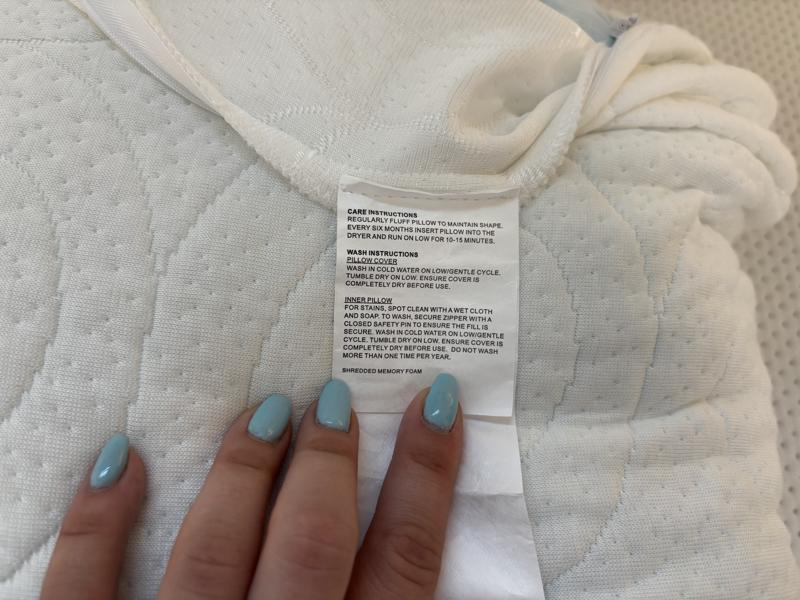
Pillow manufacturers often do their best to equip you with the knowledge you’ll need to get years of reliable use from their products. So, the easy step one is to locate that care label and have yourself a looksie.

Some pillows can be confidently deposited in the washer, others require hand washing or spot cleaning only. Hopefully, the label will give you your first clue as to how you’re going to succeed at washing your pillow properly.
You’ll want to use a mild laundry detergent and run a gentle cycle using warm water. Cold water may be fine, depending on the type of pillow, but hot water is often not recommended because it may damage the pillow.
Front-loading washers also tend to be gentler on the materials since they don’t have an agitator. You don’t necessarily have to cart your pillows to the local laundromat if you happen to have a top-loading washing machine, but you may consider running a gentle wash cycle with low or no spin cycle to reduce the risk of your pillow getting damaged.

We do not recommend using bleach on your pillow unless the label specifically says it’s okay. Bleach works well as a stain remover, but it can destroy synthetic fibers, strip natural oils from feathers, and deteriorate foam filling, leaving your pillow much worse for wear.
Your pillow is a light and fluffy delight when you’re sleeping on it, but it becomes a waterlogged wrecking ball on the inside of your washing machine, bound to knock your machine off balance at any moment. You can mitigate that possibility by washing two pillows simultaneously.
Soap suds that get stuck inside the pillow may wreak havoc on the filling, resulting in lumps and clumps that you won’t want to sleep on. Running an extra rinse cycle ensures that the soap and detergent residue gets totally washed away, keeping your pillow clean and pristine.
The type of pillow you own also factors into how you should approach cleaning it. That’s why we have a few cleaning tips and hacks based on the type of pillow you use.
Down, feather, down and feather, and down alternative pillows tend to be good in the washing machine. Use a gentle cycle with a small amount of mild detergent, but skip the fabric softener. Fabric softener is known to coat the feathers and reduce their natural fluff, which may diminish your pillow’s loft as a result.
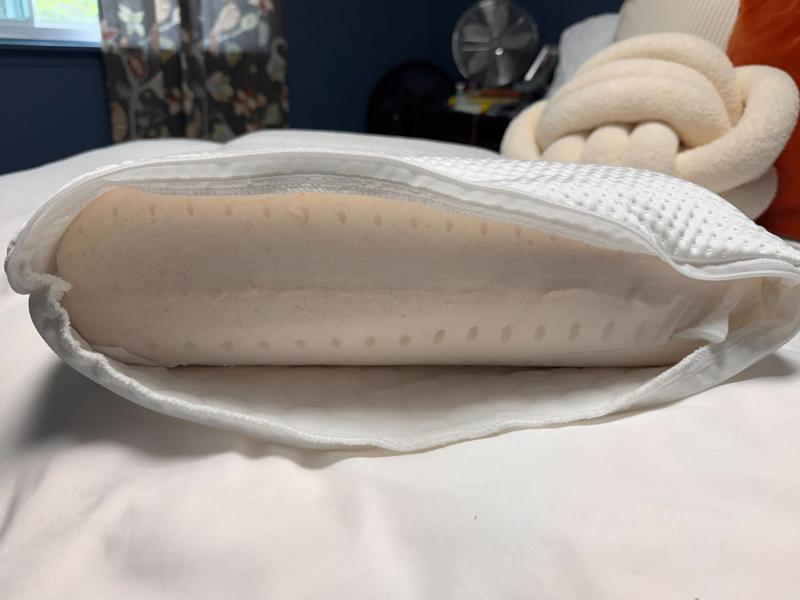
Although many latex and memory foam pillows feature removable pillow covers that may be machine washed, the pillows themselves should never go in the machine. Agitation often breaks foam apart, replacing your lovely, fluffy pillow with a limp mess.
Instead, spot-clean with a cloth and mild soap using minimal water. Always start by following the spot-cleaning instructions on the tag, and if those don’t work other spot-cleaning techniques can also be researched. There’s a whole science with lots of tricks and hacks that people have learned about spot cleaning different kinds of stains from specific materials.

Synthetic fill is durable and easy to clean, easily making it one of the most convenient and low maintenance options. They do great in the washing machine, regardless of what type you use, and tend to dry quicker than natural pillows too.
We’re talking cooling gel, wedge, contoured, and more; because these pillows typically combine multiple materials, you’ll have to follow the manufacturer’s care instructions to a T.
If the label is anything less than explicit, err on the side of caution and limit its care to spot cleaning and hand washing only.
Washing your pillow properly is only half the battle — you have to dry it properly, too.
Leaving excess water on the inside of your pillow may contribute to mold, mildew, or bad odors that you definitely don’t want anywhere near your face while you’re sleeping. So, if you want to finish the job right, you’ll want to follow our quick tips for how to dry your pillow properly too.

Remember — a pillow that stays even slightly damp can become a breeding ground for mold and mildew, putting you and your health at risk. Always make sure your pillows are totally dry before you put them back on your bed and sleep.
An occasional deep clean should help prolong your pillow’s lifespan by preventing the buildup of bacteria and allergen, but it’s not the only measure you can take to keep your pillow in top form. Here are a few more quick tips to care for your pillow and enjoy it for years to come.
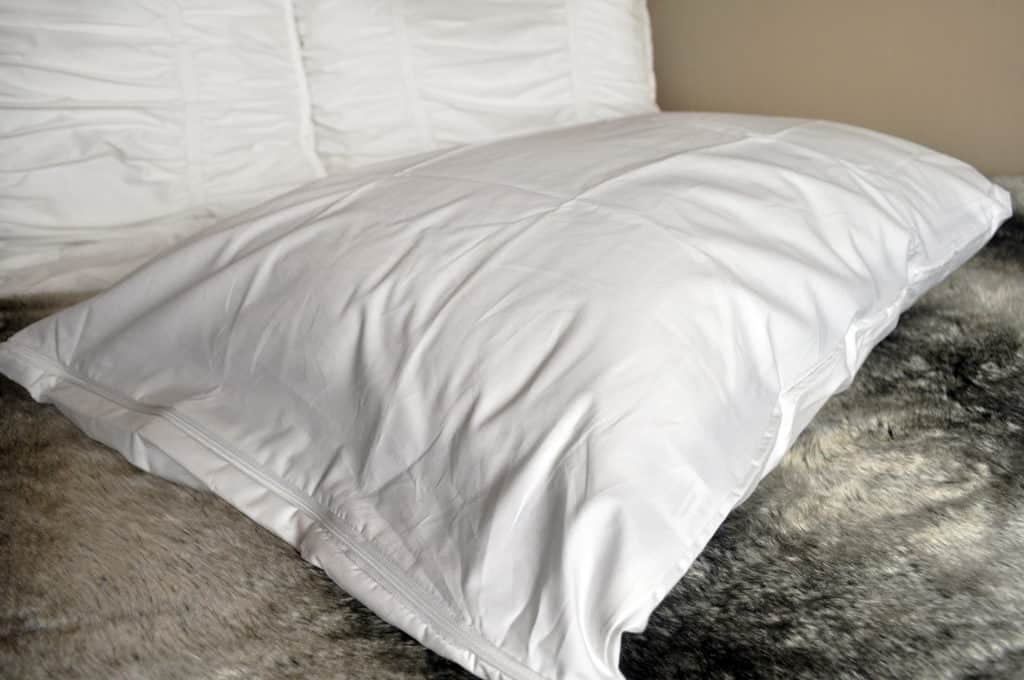
According to the Journal of Allergy and Clinical Immunology3, using a pillow protector can lead to a “significant long-term reduction in [house dust mite] allergen concentrations.”
That’s because this simple, relatively inexpensive, and conveniently machine-washable item serves as an extra barrier to absorb unwanted stuff like sweat, drool, body oils, dust mites, and other allergens that would otherwise wind up inside the pillow and become a nuisance or health hazard.

So, don’t make your life more complicated than it needs to be: Use pillow protection and buy a pillow protector today!
The filling risks clumping during the wash and dry cycles, but fluffing your pillow regularly may combat this between washes. A quick fluff every morning helps redistribute the filling, maintain loft, and keep your pillow feeling supportive. Plus, it takes literal seconds, so it’s a good habit to get into for preserving your high sleep quality and prolonging the lifespan of your pillow.
Nothing good lasts forever, and pillows are no exception. If your pillow is chronically flat, lumpy, or resistant to fluffing, then it may be time for a new pillow rather than another wash.
Often, you might see your pillow finally succumb to wear-and-tear after roughly one or two years, but you may get more life from durable synthetic pillows, high-quality down pillows, and other luxury brands that use only premium materials.
Washing your pillows regularly keeps them looking nice, and it also promotes good hygiene and healthier sleep by preventing a buildup of bacteria and allergens. Following our guide for how to wash your pillow the right way may even prolong your pillow’s lifespan, guaranteeing you get great sleep for many years to come.
So, don’t sleep on this important chore: check the care tag on your pillow and find out how to clean your pillow properly now.
The exact timing depends on what type of pillow you own, but you should expect to wash your pillow every four to six months, generally speaking. If you have allergies or tend to sweat a lot while you sleep, you may want to wash them more often than that to keep everything fresh and clean.
Down, feather, and synthetic pillows are usually machine washable, but always check the care label first. Generally speaking, memory foam and latex pillows should never go in the washer.
For down, feather, and synthetic pillows, tumble dry on low heat with dryer balls or clean tennis balls to prevent clumping. Memory foam and specialty pillows, on the other hand, should be air dried flat on a ventilated surface.
Whatever the method, make sure the pillow is completely dry to avoid mold and mildew.
Where there’s a will, there’s a way.
Pillows that are not machine washable can still be cleaned using a cloth, mild soap, and a little bit of water. A sprinkle of baking soda works well to absorb odors and excess moisture too—just don’t forget to vacuum it off the pillow before you lie down to sleep!
Of course, the best method of protection is prevention, so be sure to pair our above cleaning methods with a high-quality pillow protector, too. A combination of these tactics and things will be your best defense against bacteria, allergens, and the adverse health effects they cause.
The post How to Wash Pillows the Right Way appeared first on Sleepopolis.
]]>The post Free 10-Week Sleep Improvement Course appeared first on Sleepopolis.
]]>For the past two years, Sleepopolis has partnered with our Chief Medical Advisor, Dr. Raj Dasgupta, MD, FACP, FCCP, FAASM, to share trusted, medically informed sleep advice. Now we’re taking it a step further with a free 10-week sleep improvement course delivered straight to your inbox.
This doctor-led email program helps you:
Watch the video below as Dr. Raj explains what to expect and how to get started.
Over 10 weeks, you’ll learn how small, science-backed changes can add up to deeper, more restorative rest. Each week focuses on a specific area of sleep health so you can make steady progress at your own pace.
You’ll discover how to:
This free, doctor-led course makes better sleep simple and achievable for everyone.

Doctor-Led Expertise
Each lesson comes from Dr. Raj Dasgupta, a board-certified sleep medicine specialist who helps you apply real science to your nightly routine.

Simple, Step-by-Step Lessons
Two short emails per week guide you through practical sleep tips and habit changes you can actually stick with.

For Every Sleeper
Whether you’re struggling with occasional restlessness or sleepless nights, this program helps you find what works for your body and schedule.

Completely Free
This program is 100% free and delivered straight to your inbox. No app downloads, subscriptions, or hidden fees.
This course is guided by Dr. Raj Dasgupta, a board-certified sleep medicine specialist who has helped people improve their rest for more than two decades. It’s based on proven behavioral techniques that support your body’s natural sleep rhythm and make healthy habits easier to maintain over time.
Each lesson focuses on simple, realistic changes that add up to noticeable improvements in how you fall asleep faster, stay asleep, and feel during the day. Because the lessons arrive by email, you can follow along at your own pace and revisit any week whenever you need a refresher.
Each week of the Sleep Course includes:
These resources are designed to make improving your sleep feel simple, supported, and sustainable.
The Sleep Reset Program is designed for anyone looking to improve their sleep, whether you’re new to sleep optimization or already trying to build better habits.
The Sleep Reset Program is a 10-week program with two emails each week. You’ll get expert-led lessons on a new sleep topic in every email, along with downloadable tools, guides, and a sleep journal to help you practice what you learn and maintain better sleep habits.
Each week focuses on a specific topic to improve your sleep. You’ll explore your sleep patterns, how lifestyle factors like stress, diet, and exercise affect rest, and strategies to overcome common sleep challenges. Tools, guides, and the sleep journal help you apply the lessons as you go.
No. The Sleep Reset Program is completely free and delivered through simple, easy-to-follow video lessons straight to your inbox.
Each week includes two short emails with video lessons and downloadable tools. Most participants can complete the lessons in 15 to 30 minutes per week.
Yes. While the program is structured as 10 weeks, you can watch the videos and use the tools whenever it works best for you.
You’ll get a sleep journal, practical worksheets, checklists, and other downloadable resources to help track your progress and put the lessons into practice.
Yes. Dr. Raj shares practical tips and lifestyle strategies that can help reduce insomnia and improve sleep quality. While the program isn’t a replacement for medical treatment, the lessons cover habits, routines, and environmental changes that many people find helpful for falling and staying asleep.
Simple habits can make a big difference. Stick to a consistent sleep schedule, create a relaxing bedtime routine, and avoid stimulants or energizing activities, like caffeine, heavy meals, or vigorous exercise, right before bed.
Dr. Raj Dasgupta, MD, FACP, FCCP, FAASM, is a quadruple board-certified physician specializing in sleep medicine, internal medicine, pulmonary disease, and critical care. As the Chief Medical Advisor for Sleepopolis, he helps translate complex sleep science into practical, everyday advice. Learn more about our editorial standards.
Learn more about Dr. Raj Dasgupta →
Ready to start sleeping better?
Join the free 10-week Sleep Course and start building habits that last.
The post Free 10-Week Sleep Improvement Course appeared first on Sleepopolis.
]]>The post Cool vs. Warm Mist Humidifiers appeared first on Sleepopolis.
]]>
It might not be the first thing that springs to mind when you picture the ideal sleep environment, but optimal indoor humidity levels go a long way in supporting comfort and overall well-being. According to the Environmental Protection Agency (EPA), indoor humidity should be between 30 and 50 percent. That helps keep airways properly hydrated, which can reduce snoring, ease congestion, and prevent nighttime coughing so you can sleep soundly.
A humidifier can do the trick nicely, but what’s better — cool mist or warm mist humidifiers? While both kinds effectively raise humidity levels, the best humidifier often comes down to your climate, home environment, and personal preference. Here’s how to decide which is right for you.
As the name suggests, a cool mist humidifier pushes room-temperature moisture into the air. There are two types of cool mist humidifiers:
Cool mist humidifiers don’t have a heating element, so they’re pretty energy efficient in general, especially compared to warm mist humidifiers. That also makes them a good fit in kids’ bedrooms, because there’s no concern over burns or scalding. Cool mist humidifiers can cover a large area, so they work well in bigger bedrooms and living spaces.
On the other hand, cool mist humidifiers aren’t great in colder climates or colder months of the year. Since they don’t warm the air, they can make a room feel noticeably colder — not ideal in cold weather. You’ll also need to commit to regular cleaning to keep buildup from bacteria and mold accumulating in the tank, especially if you’re filling it with tap water.
Warm mist humidifiers are equally self explanatory. They use a heating element to boil water and then release the warm vapor into the air. That makes them soothing and cozy, especially in colder months. They don’t need a fan, so they’re usually the quietest humidifier you can get. And as a happy bonus, the heating process can help reduce bacteria in the water before it’s dispersed into the room. But that doesn’t make warm mist humidifiers germ-free, so you’ll still need to clean them regularly.
On the downside, this type of humidifier does use more energy because of the heating element. And because they get hot, they can pose a burn risk (particularly to young children and pets, who tend to be more curious). Finally, coverage areas for warm mist humidifiers are more limited than cool mist units. If your bedroom is large or has very high ceilings, a cool mist humidifier might be more effective for maintaining optimum humidity levels.
Understanding what distinguishes cool mist and warm mist humidifiers can help you decide which one will work best in your bedroom. Here’s how they compare.
Both cool mist and warm mist humidifiers can be effective for improving your sleep, especially if you live in a dry climate. But sleep is personal, so one type of humidifier may be a better fit for you specifically. Here’s what to consider.
If you live somewhere hot and dry, a cool mist diffuser will help push more moisture into the air without raising the room’s temperature. In cold, dry winter months, however, a warm mist humidifier that adds a little warmth to your bedroom may be really appealing. Warm vapor can also help ease congestion from colds.
From a safety perspective, cool mist humidifiers are a better choice in nurseries or kids’ bedrooms because they eliminate the potential for burns or scalds. If you’re considering using a humidifier in a kid’s room to help with cold symptoms like a stuffy nose, look for a model that has built-in safety features, like a cool-touch exterior, a locking lid, and an automatic shut-off feature if it gets pushed over. Make sure it’s placed somewhere out of reach and the cord is likewise secured so it can’t be pulled down.
Adding moisture to the air can be beneficial for hydrating airways and reducing general irritation from dryness, but cool mist humidifiers are typically recommended if you have allergies or asthma. Evaporative models that have built-in filters are usually best, because the filtering process helps trap common allergens and mineral deposits and keeps them from being blown into the room. That means they don’t have the “white dust” issue common with ultrasonic models, which can be irritating if you’re already dealing with allergies or asthma.
The self-regulating nature of evaporative cool mist humidifiers also prevents over-humidifying a room, another benefit for those with allergies or asthma since air that’s too damp can make symptoms worse.
Some people feel more comfortable in a cooler sleep space, so a cool mist humidifier is a natural fit. If you gravitate to something cozier, a warm mist model may be the better option. But don’t overlook room size. A warm mist humidifier works better in a smaller space because it works via passive evaporation, while a cool mist unit can handle bigger rooms and taller ceilings.
The cool mist vs warm mist humidifier debate ultimately comes down to weighing their individual strengths and weaknesses. Here’s what to consider.
If your goal is adding moisture to dry indoor air, both cool mist and warm mist humidifiers get the job done. Deciding between the two is a matter of identifying what matters most in your home. Cool mist humidifiers add room-temperature moisture to the air and work better in large spaces. They work well in warmer climates or during the summer, and they can be a good choice year-round in milder climates. Plus, they’re safer in homes with kids or pets.
Warm mist humidifiers cozy things up in colder weather and are typically a quieter option. But they cover smaller areas, use more energy, and have a heating element that can be a safety concern with children or curious animals.
Factoring for your sleep environment, your health goals, and your personal preferences is the best way to decide between cool mist and warm mist humidifiers. Either way, you can add much-needed moisture to your bedroom, which may be exactly what you need for more restful nights.
A cool mist humidifier is a better choice in a baby’s room because they don’t use heat, so there’s no risk of burns from hot water. They’re an efficient way to humidify the air, which helps ease congestion and discomfort from dry air.
Warm mist humidifiers have a boiling process that can help reduce bacteria in the water before it’s released, but it doesn’t mean the mist is entirely germ-free. You’ll still need to clean the humidifier regularly.
If you want to use essential oils, make sure your humidifier is compatible. If it’s not, the oil can clog filters or even cause damage to internal parts.
Both cool and warm mist humidifiers can help with allergy symptoms by hydrating nasal passages, cool mist models that use evaporative technology are usually the better choice. They typically have filters that can trap common allergens, and they work well in larger spaces.
The post Cool vs. Warm Mist Humidifiers appeared first on Sleepopolis.
]]>The post How to Wash Down and Feather Pillows appeared first on Sleepopolis.
]]>Everyone knows the importance of regularly washing and changing their bed sheets, yet many people sleep on keeping their pillows clean too. Sure, washing down pillows or feather pillows may seem daunting, but it’s not as involved as you’d think. All you need is a little know-how.
That’s where your pals at Sleepopolis come in. We put together this safe and effective guide on how to wash and dry your down and feather pillows so that they stay fresh, fluffy, and functional for years to come. So, wake up and let’s get washing!
Most people are down with down and feather pillows, but what exactly are they and what makes them so special?
Down and feathers come from ducks and geese: Down refers to the soft, fluffy underlayer, whereas feathers are the tougher outer layer you see when you look at a duck or goose. Because ducks and geese need to be light enough to fly and warm enough to survive in cold weather, these feathers are naturally light and insulating.
You can buy 100-percent down pillows or feather pillows, but many manufacturers mix down and feathers to get the best of both worlds. Down provides that cushy, comfy feeling most sleepers yearn for, while feathers give the pillow a little structure and shape.

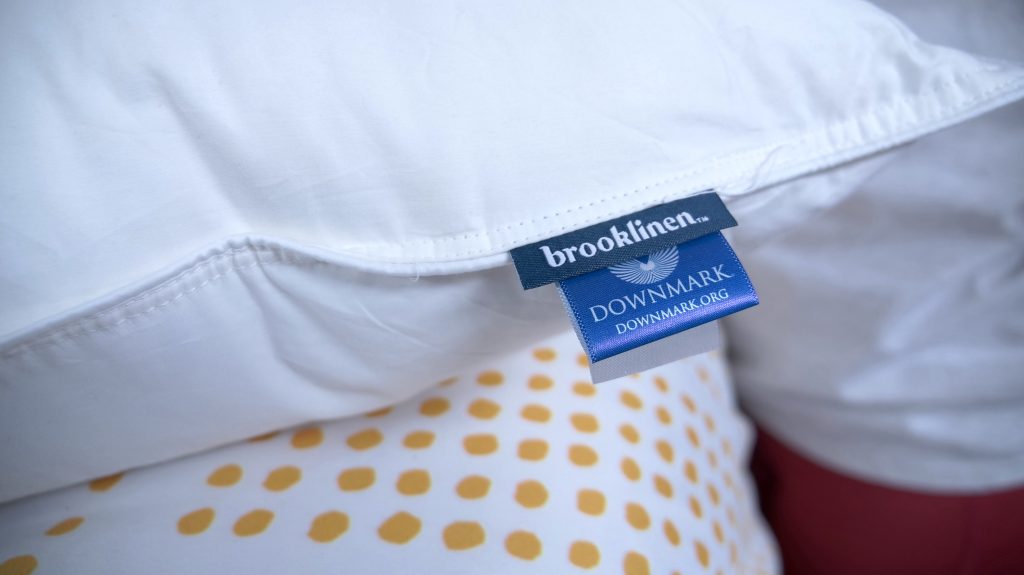
Down-alternative pillows have become increasingly popular over the years as well. These pillows use synthetic fibers like polyester to mimic the feel of down. They’re generally easier to wash, but they tend to lack the same natural loft and breathability you get from authentic down.
Not sure if a down and feather pillow is right for you? No worries; check out the pros and cons of down pillows and feather pillows below or check out our guide on how to choose the right pillow.
Down and feather pillows are soft, delicate, premium, and luxurious, so great care is required if we’re going to preserve those naturally decadent features and enjoy some longevity from your pillow.
Never fear; Sleepopolis is here to give you the step-by-step breakdown of how to clean your pillow safely and effectively.
Many manufacturers print instructions for how to properly care for your pillows right on the tag, so you can easily determine if you must hand wash the pillow or if machine washing is in bounds. Thankfully, most down and feather pillows are machine washable, meaning clean pillows are only a few short washing and drying cycles away.

No tag? No problem. Skip to the next step.
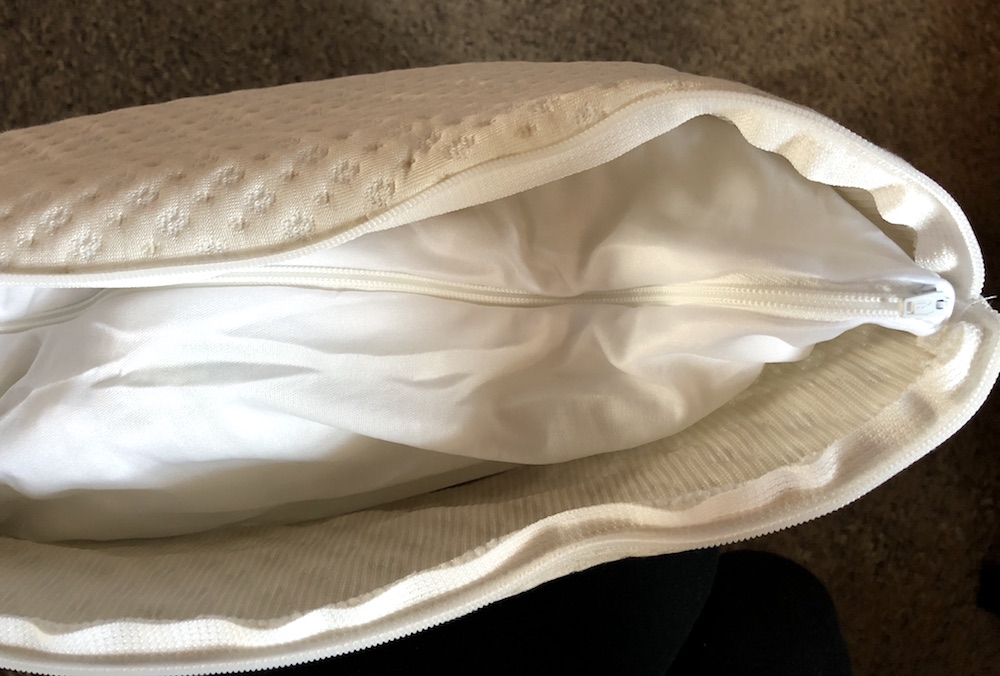
Some down and feather pillows feature a zippered pillow cover that can be removed. They make the cover removable so you customize your sleeping experience by adding or removing fluffing, but it also makes cleaning much easier.
If your pillow has a zippered cover, unzip it and remove the pillow from the cover now.

Enough with the prep talk. It’s time to get down to business.
Place your down and feather pillow in the washer, select the gentle cycle, and wash it using cold water. Some manufacturers may say that warm water is fine, but hot water is a big no-no and may damage the pillow.
Use a low-sudsing or mild detergent to ensure your pillow gets squeaky clean while minimizing the chance of having soap residue sticking around. Choosing to run an extra rinse cycle may be prudent as well since that excess water works to wash away residual laundry detergent and soap buildup.
We also recommend using a front-loading washer, if possible, because top-loading washers may not fully soak the pillow and tend to be rougher on the materials, especially if they have an agitator. You may consider schlepping your sleeping stuff to the local laundromat if you don’t have a front-loading washing machine at home.
Washing your down and feather pillow is important, but failing to dry your pillow properly risks you winding up with clumpy, funky-smelling pillows that make your sleeping experience uncomfortable, unsanitary, and potentially unsafe.
Here are are our quick tips for making sure you get that pillow dried and bedtime-ready again:
We completely understand if you’re nervous to wash your down and feather pillow, especially given that some of the best down pillows may be on the pricier side, but washing your pillows is very important for the same reasons it’s important to wash your bedding.

Think about it: You lay your head down on that pillow night after night all year long. Unless you’re using pillow protectors, yucky stuff like sweat, body oils, dead skin, drool, and even dust mites find their way onto your pillowcase and eventually onto the pillow.
A good wash eliminates this stuff and makes them like new, both extending your pillow’s lifespan and supporting better quality sleep.
Thankfully, you don’t have to set aside time to clean your pillow every week with your regular batch of laundry. Washing your down and feather pillows every 4 to 6 months is often more than enough to keep them pristine and ready for your dreams.
However, you may need to clean them sooner if they start smelling musty, begin feeling flat or heavy, or wind up with visible stains or discoloration.
Knowing how to clean your pillows is important, but sometimes it’s just as important to know what you’re not supposed to do so you can avoid some common pitfalls. Here are a few quick no-nos to ensure you don’t make a dire mistake while washing your down and feather pillows:
Washing your down and feather pillows seems scary at first, but follow our steps and you’ll be well on your way to the luxurious sleeping experience you dream of.
Absolutely not. High heat can damage the pillow irreparably, so — say it with me one more time — low and slow is the way to go. Air-drying is also an option, although you’ll need to set aside more drying time if you’re using this method.
Washing your pillow should not ruin the fluffiness or feather filling. Residual soap left behind after the rinse or failing to fully dry your pillow, on the other hand, may ruin the fluff. So, it’s important to make sure you completely rinse out all the soap and fully dry your pillow.
If done properly, washing may actually improve the fluff and result in a loftier, comfier pillow.
A funky odor after you wash your pillow is a telltale sign that it didn’t get fully dry and may indicate the presence of mildew. The best way to remedy this is to run another gentle cycle with a touch of detergent and run two or three cycles in the dryer right afterwards using our pro tips above.
With a little time and care, you can wash that pillow like a pro and enjoy a premium sleeping experience pronto.
The post How to Wash Down and Feather Pillows appeared first on Sleepopolis.
]]>The post What Happens to Your Body During Sleep: A Children’s Guide appeared first on Sleepopolis.
]]>Note: The content on Sleepopolis is meant to be engaging and informative in nature, but shouldn’t be taken as medical advice for either you or your children and should never supersede the opinion of a trained professional. If you feel like your child may be suffering from a sleep disorder or any other medical condition, please see your healthcare provider immediately.
When you’re asleep, your body is in a resting state. You’re usually lying down, your eyes are closed, your muscles are relaxed, and you’re not aware of what’s going on around you. At night, the brain makes a chemical called melatonin that makes you tired. In the morning, sunlight tells your brain it’s time to wake up and start your day. Because light helps to wake you up, even the light from a TV can keep you up at night. Sleep is made up of five stages. It takes about 90 minutes for you to go through all of the stages of sleep, and the entire cycle is usually repeated about five or six times during the night.

Stage 1 is the lightest stage of sleep and happens when you’re drifting off. During this stage, you can be woken up easily. This is also the stage when you may have the feeling that you’re falling. Stage 1 is also the stage in which you wake up if you are not woken by an alarm clock or your parent. This stage is short, lasting just 5 to 10 minutes. During Stage 1, the eyes move slowly, muscle activity slows down, and your body relaxes to allow you to reach Stage 2.
When you reach Stage 2, your eye movement stops and brain waves slow down. However, there are still short bursts of higher brainwave activity, called K-complexes and sleep spindles. Your breathing and heart rate also slow down, and your body temperature falls a little. There are no dreams in this stage. Its main purpose is to relax and prepare the body for a deeper stage of sleep. You spend about half of your entire night in Stage 2.
In Stage 3, your brain shows delta-wave or slow-wave activity. There may still be short bursts of faster activity throughout this stage, known as beta-waves. During this stage, you cannot be as easily woken up. If you do suddenly wake up, you will probably be confused and groggy. It will also be hard to focus for a couple of minutes. There is no voluntary muscle movement or eye movement, and there is also no dreaming. Stages 3 and 4 are when most sleepwalking occurs. Stage 3 usually lasts about 30 minutes.
Stage 4 is the deepest stage of sleep, making it difficult to wake someone up. This stage shows only delta-wave activity in the brain, and muscle activity is greatly decreased. If you are woken up during Stage 4, you may have trouble thinking clearly. If you’re going through Stage 4 for the first time in a night, you’ll likely remain in this stage for about an hour. This time allows your body to repair itself. Future occurrences of Stage 4 might only last about 5 to 15 minutes.
Stage 5 is also called REM, which stands for rapid eye movement. During REM sleep, the eyes move around quickly. Your blood flow, brain activity, and breathing speed up. The first period of REM usually starts about 90 minutes after you fall asleep and lasts about 10 minutes. Throughout the night, the REM stage becomes longer. The final REM period lasts about an hour. Stage 5 is usually the stage when you dream.

If you don’t get enough rest at night, you may feel tired or cranky the next day. You may find it hard to concentrate at school and at home. You probably won’t have the energy to have fun with friends or go to sports practice or other activities. When you don’t get enough shut-eye on a regular basis, you may not grow as well as you should. Not enough rest can also affect your immune system, which prevents you from getting sick.
The post What Happens to Your Body During Sleep: A Children’s Guide appeared first on Sleepopolis.
]]>The post The Perfect Bedtime Routine for Kids appeared first on Sleepopolis.
]]>Establishing a regular bedtime routine for your child will make it much easier for them to get the right amount of sleep. Having a routine that is consistent night after night and is preceded by a defined set of steps gets your child into the right state of mind for sleep, and makes things far less hectic when it comes time to turn out the lights.
Every time we eat, our body starts metabolic processes that can help or hinder sleep. The same is true for children, so it is essential that you carefully monitor what your child consumes before bedtime. Some experts recommend having dinner no later than about 2 or 3 hours before it is time to go to bed, and the earlier the better, if eating tends to rile your child up. After dinner and before bedtime, it is appropriate for your child to have a snack, as long as it includes the right foods.
Processed sugars should be avoided, as they may keep your child awake. The best foods for promoting sleep include complex carbohydrates, such as whole wheat bread or crackers and tryptophan-containing foods, such as cheese, yogurt, or peanuts. It is recommended that no food be eaten later than 20 minutes before bedtime.

What your child drinks before bedtime can also have an adverse effect on sleeping and increase the likelihood of bed-wetting. Note that it is not just the amount of liquid that is consumed that may be the problem, but rather the kinds of things that your child drinks. Until your child is able to wake up in the middle of the night and go to the bathroom, it is wise to reduce the amount of liquid they drink before going to bed; however, you should be careful not to reduce the amount so much that your child goes to bed thirsty or becomes dehydrated.
When considering the amount of liquid consumed before bedtime, remember that certain foods, such as fruits and vegetables have a high water content. Also, make sure that your child does not have any caffeinated drinks after the late afternoon. That means no coffee, tea, or caffeinated sodas.
A bedtime routine that includes relaxing activities and gives your child some sense of ownership over the process is also conducive to better sleep. In addition to standard activities, such as brushing their teeth, things such as a calm, warm bath will help get the body ready for sleeping.

Allowing your child to pick out pajamas and the bedtime story they want to hear is also a good idea; it gives your child something to look forward to and can make them more willing participant in the bedtime routine. Other helpful activities that can promote good sleeping include singing your child’s favorite lullaby and saying a prayer or expressing thanks for the day, its activities, and friends and family.
A set bedtime routine is important, but the right atmosphere for sleeping is also necessary for your child to get adequate rest. Your child’s bedroom should be dark, so heavy curtains are recommended to help block out light. Keeping the room at a temperature of between 64° and 75°F will also make the atmosphere more conducive to a good night’s sleep.
Finally, many sleep experts are now recommending that parents make their kids’ bedrooms into “screen-free” zones. That is, keeping computers, mobile devices, tablet computers, televisions, and other similar things out of bedrooms will contribute to a better night’s sleep for your child.
Until a good, personalized bedtime routine is established, getting your child into a bedtime routine can be difficult. Some parents may find that offering certain incentives for following all the routine’s steps and staying in bed until morning can make this process smoother. Creating a chart that lists the steps of the routine and then giving a prize after your child does them for a certain number of days can help encourage them to follow the bedtime program. The reward does not have to be complicated or fancy; most children are quite happy with even the smallest incentives if they feel like they’ve earned it themselves.
The post The Perfect Bedtime Routine for Kids appeared first on Sleepopolis.
]]>The post 45 Beverages Ranked by Caffeine Per Ounce appeared first on Sleepopolis.
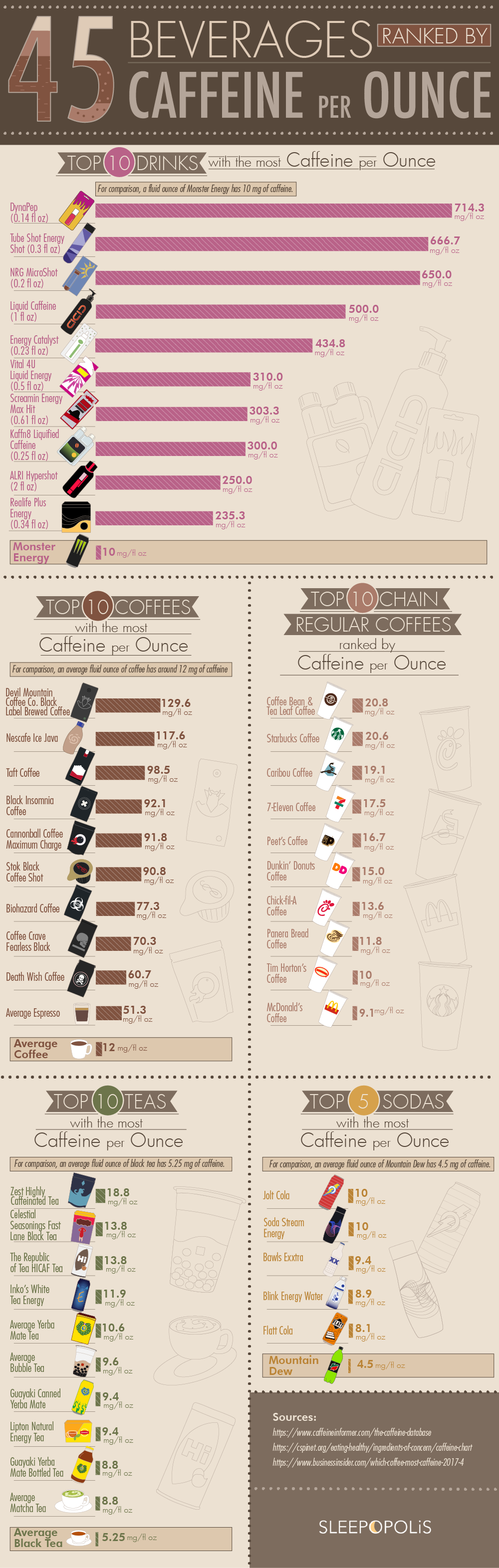
]]>Curious to know which drinks contain the most caffeine? Check out our infographic below to find out!

Want to share this infographic? Use this link or the embed code below!
At 714.3 mg per fluid ounce, DynaPep has the highest caffeine content per ounce of any beverage on the market. Fortunately, it comes in tiny 0.14-ounce portions.
Despite DynaPep’s minuscule size, it packs a powerful punch. The time-released microshot (created by Florida company Intocell) claims to increase focus and boost energy for up to 10 hours. It contains a derivative of methylhexanamine, a stimulant that is believed to actually have a negative effect on mental clarity. Reports of dangerously elevated heart rates are also associated with this drug.
On an ounce-by-ounce basis, coffee overall delivers more caffeine than energy supplements, shots, and drinks. Devil Mountain Co. Black Label Brewed Coffee is believed to have the most caffeine per ounce at 129.6 mg.
And when it comes to brand name caffeine, Coffee Bean & Tea Leaf’s regular coffee packs the most caffeine per ounce at 20.8 mg. That’s more than twice the amount of caffeine offered in McDonald’s coffee (9.1 mg per fluid ounce). Starbucks lands a close second at 20.6 mg per fluid ounce, with Dunkin’ Donuts lagging behind at 15 mg.
Phew, we know! These numbers are intense. While an average fluid ounce of coffee typically features just 12 mg of caffeine, the beverages on this list soar well beyond that. Like us, you’re probably wondering if ingesting that much liquid energy is actually, well, safe. The long and short of it is… maybe.
But before we get into that, let’s take a step back and chat about what caffeine actually is.
Caffeine is a bitter, white crystalline purine of the methylxanthine class found in over 60 varietals of plants, seeds, and leaves in Africa, East Asia, and South America. While some anecdotal evidence suggests that caffeinated tea was discovered by Chinese Emperor Shennong in as early as 3000 BCE, it’s generally accepted that the first credible case of coffee consumption came in the 15th century in the Middle East. Over the next 200 years, it would spread throughout the region, into Asia, and then eventually into Europe by the 18th century. (1)
Nowadays, about 90 percent of Americans consume caffeine in some shape or form during the day. (2) This number is consistent with global statistics, with some experts gauging that over 2.25 billion cups of coffee are served daily.
So, how exactly do we get from leaves to one of the world’s most booming industries? Typically, farmers soak the plants in water until the liquid has been infused with the purine’s properties. As deceptively simple as that! For this reason, the strength of any given batch of coffee (or tea, or chocolate) can vary depending on the specific plants used.

The subject of caffeine consumption has long been a topic of interest for modern researchers and scientists. Does too much cause memory loss? What about hypertension or anxiety? Is there even a thing as too much caffeine? Unlike other substances on the market, caffeine isn’t really regulated at all, so people can truly ingest as much of the stuff as they want. But at what cost?
All in all, regular and even heavy amounts of caffeine use appear to be totally fine for healthy adults. A 2017 analysis of dozens of reports, papers, and experiments on the subject found that adults can safely consume 400 mg/day without suffering from adverse effects on cardiovascular health, calcium balance and bone status, behavior, cancer risk, or fertility. The prescribed number decreases to 100 mg/day for healthy adolescents (12-18 years old) and 2.5 mg/day for children (younger than 12 years old). (3) So while a single Dynapep may indeed be “too much,” most folks can safely intake several cups of coffee before even approaching the danger zone.
However, there are certain populations for whom caffeine consumption becomes a little trickier. According to the above report, groups such as pregnant and lactating women, young children, and people with underlying heart or mental health conditions may need to avoid caffeine altogether.
While that’s all well and good, we are of course a sleep website, so feel it’s important to chat a bit about the caffeine effect on sleep cycle.
It basically works like this: When the brain is tired, it creates more of a substance called adenosine, which binds to adenosine receptors to slow down nerve cell activity. Caffeine tricks these receptors by essentially pretending to be adenosine, thereby binding to the receptors and blocking the sleep-inducing element. The more caffeine, the more receptors that are blocked.
The result is a nearly instantaneous feeling of wakefulness that can last for up to 3–4 hours. Though it may seem like a pitch perfect solution to drowsiness, the drawbacks are numerous: headaches, eventual grogginess, and increased anxiety, to name just a few. Studies have also shown that increased caffeine consumption during the day can lead to serious sleep problems at night, with one report suggesting that individuals should stop ingesting caffeine 6 hours before bedtime. (4)
The solution? As with any mood-altering substance, it’s moderation. Grab a cup of coffee in the morning, but also remember to establish a consistent bedtime and get yourself the best mattress for your sleep preferences. Snag a soda after work if you’re feeling sluggish, but don’t skimp on the nighttime practices you’ve put in place to catch those sweet, sweet Zzz’s.
Need help falling asleep? Snag one of the best pillows!
| Rank | Drink and Serving Size in fl oz | Caffeine Per Ounce |
| 1 | DynaPep (.14 fl oz) | 714.3 mg/fl oz |
| 2 | Tube Shot Energy Shot (.3 fl oz) | 666.7 mg/fl oz |
| 3 | NRG MicroShot (.2 fl oz) | 650.0 mg/fl oz |
| 4 | Liquid Caffeine (1 fl oz) | 500.0 mg/fl oz |
| 5 | Energy Catalyst (.23 fl oz) | 434.8 mg/fl oz |
| Rank | Coffee Chain | Caffeine per Ounce in Their Regular Coffee |
| 1 | Coffee Bean & Tea Coffee | 20.8 mg/fl oz |
| 2 | Starbucks Coffee | 20.6 mg/fl oz |
| 3 | Caribou Coffee | 19.1 mg/fl oz |
| 4 | 7 Eleven Coffee | 17.5 mg/fl oz |
| 5 | Peet’s Coffee | 16.7 mg/fl oz |
The post 45 Beverages Ranked by Caffeine Per Ounce appeared first on Sleepopolis.
]]>The post Does Warm Milk Help You Sleep? appeared first on Sleepopolis.
]]>But what’s the actual science behind it? We’ll be exploring the role of milk nutrients, such as tryptophan and melatonin, in supporting relaxation and sleep, as well as the psychological role of sipping something warm like milk before bed. For example, it may be a soothing part of their bedtime routine or recall pleasant childhood memories.
Note: The content on Sleepopolis is meant to be informative in nature, but it shouldn’t be taken as medical advice, and it shouldn’t take the place of medical advice and supervision from a trained professional. If you feel you may be suffering from any sleep disorder or medical condition, please see your healthcare provider immediately.
Drinking warmed milk at bedtime may help some people rest easier, though the evidence is mostly anecdotal. While science hasn’t firmly validated the milk-sleep association, many people find that a warm beverage soothes the belly. For some, the act of sipping on a warm beverage as a regular part of your nightly routine may also build a mental association, signaling to your body that it’s time to relax for the evening. The potentially relaxing effect of warm milk may also have to do with some of its nutritional components.
As the interest in natural sleep aids grows, many people turn to time-honored traditions (sometimes nostalgic of their childhood) in hopes of supporting their bedtime routine without using medication.
The soothing temperature and key nutrients — like calcium, vitamin D, and tryptophan — found in milk are most often credited for its potential sleep-promoting abilities. (2)
First, calcium and vitamin D appear to be involved in regulating the sleep-wake cycle, while protein helps maintain steady blood sugar levels — which may help prevent disrupted sleep. (3)(4)(5)(6)
Mike McGrath, a board-certified psychiatrist and chief clinical officer at The Oasis recovery center says, “Milk contains tryptophan, a precursor to the sleep-promoting hormone melatonin, which helps regulate the sleep-wake cycle.” Still, it’s worth noting that the amount of tryptophan in a typical glass of milk is probably too small to have a substantial impact by itself — and you’re unlikely to consume enough of this amino acid from foods to experience a direct effect on your energy anyway. (7)(8) Learn more about these key nutrients below.
Tryptophan is an amino acid found in milk, as well as poultry, eggs, soy products, nuts, and legumes. It plays a role in sleep by supporting the production of serotonin, a neurotransmitter that influences your mood and relaxation. (2)
Serotonin is then converted into melatonin, AKA “the sleep hormone,” which is involved in regulating your sleep-wake cycles. This series of events has led to the popular belief that drinking warm milk before bed can promote better sleep.
While milk does contain tryptophan, it’s not the only food source you can get it from; you can also find tryptophan in poultry, legumes, oats, and bananas. Additionally, one cup of milk provides around 100 mg of tryptophan, which is far less than the amounts often used in studies (often at least 1 gram) to observe direct sleep benefits. (8)(9)(10)(11) For reference, there are 1,000 mg in 1 gram.
Melatonin regulates your sleep-wake cycle by signaling to your brain when it’s time to wind down and prepare for rest. It’s secreted as you near bedtime, peaks in the middle of the night, and then declines as your body gets ready to wake with daylight. This natural fluctuation in melatonin levels helps maintain circadian rhythms, ensuring you fall asleep and wake up at the right times. (12)
One of the reasons drinking warm milk before bed is considered a potential natural sleep aid is because it contains small amounts of melatonin. However, the amount of melatonin found in milk is minimal and is not likely to make significant changes.
For comparison, most melatonin supplements contain between 0.1 mg to 10 mg per dose, while a cup of milk contains trace amounts — and is unlikely to have a significant direct impact on sleep. (13)
Overall, while melatonin and tryptophan from warm milk may have very subtle calming effects on your body, they’re most likely used as a comforting measure to aid relaxation and prepare for a good night’s rest.
When you think about the types of beverages you’re more likely to reach for to calm down before bed, they’re probably warm. Just like wearing a cozy sweater is comforting on a winter day, a cozy drink can soothe your body before lying down to rest.
Drinking warm milk is often perceived as more calming due to the warmth it provides your body from the inside out. This may help signal your body to get ready for sleep. While there’s no direct research on warm milk and sleepiness, some studies suggest an association between physical warmth (like, drinking a warm mug of milk) and emotional or mental warmth (which may help us relax). (14)
There could also be some psychological benefits related to the ritual of slowly sipping on a warm liquid — similar to how many of us believe we can’t function in the mornings without our coffee.
Cold milk, on the other hand, can be refreshing and hydrating but doesn’t offer these same thermal effects. Most people probably don’t think of downing a cold carton of milk when they’re looking to relax at bedtime.
Still, the only real difference between milk served cold or warm is its temperature. You’ll get the same nutritional components either way, meaning that any sleep benefits from milk itself aren’t affected by the temperature at which it’s served.
If the main reasons why warm milk may help with sleep are temperature and nutritional components, you may be curious whether there’s a difference between dairy and non-dairy milk. Remember, dairy naturally contains small amounts of tryptophan and melatonin, which can support sleep in the right quantities. (15)
Catherine Gervacio, registered dietitian and nutrition writer for Living.Fit, says that non-dairy options like almond or oat milk don’t naturally have tryptophan. However, if they’re enriched with magnesium, they might help relax your muscles and calm the mind. (16) “Warm milk of any kind can also be soothing due to its warmth and texture, signaling your body that it’s time to wind down,” she says.
Whether you like sipping on warm milk or using other natural sleep aids, each can offer a unique approach to relaxation depending on your personal preferences. For example, herbal teas and aromatic essential oils are other popular picks for soothing the mind, such as:
Compared to these remedies, warm milk’s effects are less directly tied to specific compounds and more reliant on its comforting warmth and association with bedtime routines.
When choosing the best sleep aid for you, consider your personal preferences and how one might fit into your routine better than another. If it’s a ritualistic, comforting experience you’re seeking, perhaps you would like warm milk or chamomile tea before bed. If you’re looking for a calming aromatic experience, lavender may be a better fit.
Finally, Gervacio says, “Always pair [what you choose] with a calming bedtime routine like meditation, soothing music, and other stress management habits.” Sleep hygiene habits, like keeping a consistent sleep schedule and avoiding stimulants before bed, are essential to sleeping better. (20)
While warm milk before bed can be a relaxing ritual for some, that doesn’t mean it’s the best answer for everyone trying to catch more Z’s.
For instance, if you have lactose intolerance, any soothing effects of warm milk at bedtime likely don’t outweigh the potential bloating, gas, or cramping that may occur (and probably disrupt your sleep). (21)
If you’re prone to acid reflux with high-fat foods, drinking milk close to bedtime and then lying down may also exacerbate symptoms. (22) And if drinking liquids too soon before lying down gives you nocturia (keeps you up frequently at night having to pee), it may be best to limit it.
Additionally, milk contains calories (more per serving with higher-fat versions) and regularly consuming it before bed could contribute to a higher caloric intake. This may ultimately lead to unintentional weight gain over time if it’s not taken into consideration with your overall dietary intake.
If you’re unable to or choose not to consume dairy, lactose-free milk or plant-based milk can still provide warmth and comfort without the potentially problematic lactose. You might also opt for an herbal tea or other natural sleep remedy altogether.
Warm milk has long been considered a natural sleep aid, helping soothe tummies and calm minds everywhere in preparation for rest. While there may be some sleep-promoting properties associated with milk, it’s most likely because warm milk is, well, warm and ritualistic. If warm milk isn’t your thing, you might consider other options, like herbal tea or aromatherapy, along with good sleep hygiene practices.
Milk is thought to make you sleepy due to its tryptophan content, an amino acid that supports serotonin and melatonin production, which regulate sleep. The temperature of warm milk is likely the real reason milk makes us sleepy, though it’s much more of a ritual/habitual act that brings forth a calming effect.
The effects of warm milk on sleep vary from person to person. The act of sipping on something warm can help your mind focus on the task at hand, reducing distractions and calming you down within 20–30 minutes.
If drinking warm milk before bed helps you relax and sleep better, it may be a good practice for your needs and goals. However, it’s not for everyone. For instance, people who have lactose intolerance, acid reflux, or are concerned about overall calorie intake may be better off choosing plant-based or herbal alternatives or seeking non-food sleep aids instead.
The post Does Warm Milk Help You Sleep? appeared first on Sleepopolis.
]]>The post A Guide to Shift Work Sleep Disorder appeared first on Sleepopolis.
]]>Note: The content on Sleepopolis is meant to be informative in nature, but it shouldn’t be taken as medical advice, and it shouldn’t take the place of medical advice and supervision from a trained professional. If you feel you may be suffering from any sleep disorder or medical condition, please see your healthcare provider immediately. Additionally, restrictions and regulations on supplements may vary by location. If you ever have any questions or concerns about a product you’re using, contact your doctor.
Shift work sleep disorder occurs when you have trouble adjusting to your sleep and wake times because of your work schedule. (2) You might picture someone working the graveyard shift, but shift work disorder affects anyone working non-traditional hours, whether that’s nights, early mornings, rotating shifts, or any schedule outside the typical 9-to-5. (2)
This type of work schedule often forces you to sleep at a time during the day that clashes with your body’s circadian rhythms, Eric Olson, M.D., pulmonologist and sleep medicine specialist at Mayo Clinic and president of the American Academy of Sleep Medicine, tells Sleepopolis. (3)
In fact, shift work disorder is a type of circadian rhythm disorder. (4) (5) Think of your circadian rhythm as your internal timekeeper, following a 24-hour schedule based on daylight. When it’s dark, your body releases melatonin (the sleep hormone) to help you sleep. (6)
“When an individual is experiencing a shift work disorder, their body may produce melatonin when they need to be alert and awake at their job,” Olson says. As a result, your body’s sleep signals come at the wrong times, making it hard to stay alert at work and sleep well at home.
This mismatch can also cause both short-term and long-term issues. You might experience insomnia (trouble falling asleep or staying asleep), excessive sleepiness during work, fatigue, and more. (4) Over time, shift work disorder can affect your immune system and increase your risk of heart disease and obesity. (7) We’ll dive deeper into the symptoms below.
What is shift work? If your workday happens outside the typical 9-to-5 schedule, chances are you’re doing shift work. This type of work schedule includes: (7) (8)
Here are some common shift work jobs:
If you’re dealing with shift work sleep disorder, there’s usually more going on than just feeling tired.
“The sleep disturbance leads to increased sleepiness and/or insomnia,” Brittney Jones, PsyD, a licensed clinical psychologist and board-certified insomnia specialist, tells Sleepopolis. But the impact goes way beyond sleep issues.
Common shift work sleep disorder symptoms include: (7) (9) (10)
There’s more: these sleep disruptions can impact your work performance and your social life, Jones explains. You might experience relationship struggles and feel isolated from loved ones. (11) And it can be hard to be your best self when you’re constantly fighting your body’s natural sleep rhythm.
If you’re nodding along to these symptoms, it’s worth talking to a healthcare provider or sleep specialist. In the meantime, stick around. We’ll cover some practical ways to manage these symptoms and help you get the quality sleep you deserve.

Your body’s circadian rhythm has a straightforward job: to keep you awake during daylight and help you sleep when it’s dark at night. (12) When you work non-traditional hours, like nights or rotating shifts, you’re asking your body to go against its natural design. This means working during times your body expects to rest, and when it can’t adapt, shift work disorder may develop.
“Shift work sleep disorder is fundamentally caused by missing sleep at night,” Alex Dimitriu, M.D., double board-certified in psychiatry and sleep medicine, tells Sleepopolis. The more your schedule differs from normal nighttime sleep, the harder it gets, especially if your shifts keep changing, he explains. (4) For example, working an evening shift might be more manageable than an overnight shift or having your schedule flip-flop between day and night shifts every few days. (4)
Several factors can make you more likely to develop shift work disorder:
Still, not everyone who works non-traditional hours develops shift work disorder. (7)
Remember those nearly 24 million Americans we mentioned who work non-traditional shifts? Let’s look at what research tells us about shift work’s impact:
You can start with a self-assessment. Olson suggests asking yourself these questions:
If you answered yes to these questions, it’s time to talk to a sleep specialist. “People with SWSD usually see a healthcare provider to have this condition diagnosed,” Jones explains. You’ll likely be asked to keep a sleep log for about two weeks — tracking when you sleep, how long it takes to fall asleep, and how refreshed you feel when you wake up. (17)
Healthcare providers will use this sleep log to confirm that your sleep troubles are connected to your work schedule and have been going on for at least three months, Jane Dyonzak, Ph.D, a licensed clinical psychologist specializing in sleep and behavioral medicine, tells Sleepopolis.
You may also need some tests for an accurate diagnosis. You might be asked to wear an actigraphy device (think of it as a specialized activity tracker) that measures your movements during day and night to get a clearer picture of your sleep patterns. Some people may also need a sleep study to check for other sleep disorders like obstructive sleep apnea or narcolepsy, Jones says. (17)
You may not be able to change your work schedule, but you can help your body get with the program. The goal of shift work disorder treatment is to reset your internal clock to match your work hours, and your healthcare provider may recommend a few ways to help make this happen: (18) (19)
Shift work sleep disorder can affect your health in multiple ways. Let’s look at what researchers have discovered so far:
Working odd hours can take a toll on your heart health. A small study of female night shift workers found that disruptions to the internal clock from shift work can change how certain genes related to the body’s daily rhythm function, which may increase the risk of developing heart disease over time. (20)
Shift workers are also at higher risk for sleep apnea, and when combined with sleep deprivation, their risk of heart problems can be twice as high as those without sleep issues, according to a review of studies. (21) However, some of these findings need more research to be confirmed.
Night shift workers are more likely to develop metabolic syndrome, a cluster of health issues that include high blood pressure, high blood sugar, and increased body fat around the waist. (22) (23)
On top of that, there’s a link between working an increased number of night shifts and high blood pressure, although this connection still needs more research. (23) And eating when your body expects to be sleeping doesn’t help, either. Your internal clock can affect how your body processes food, so eating at night when your body is programmed to fast can disrupt your natural metabolic rhythms. (10)
Shift workers often find it harder to maintain a healthy weight, and it’s not necessarily due to late-night snacking. Research shows that eating later in the day is linked to greater body fat, even if you’re not consuming more calories. (10) When shift work forces you to eat at unusual times, your body’s metabolic processes can get confused, potentially making weight management more challenging. (10)
With a disrupted sleep-wake cycle, your immune system can also take a hit. According to a small study, night shift workers have higher levels of monocytes (a type of immune cells) compared to day workers. (24) These disruptions may make shift workers more susceptible to colds, the flu, and other infections. (7)
The relationship between shift work and cancer isn’t clear, but researchers have noticed some patterns. Long-term night shift workers, especially those who started before age 30 and work three or more nights per week, may have an increased cancer risk, especially for breast and prostate cancer. (25) But other factors in shift workers’ lives might contribute to this increased risk, like higher stress levels and lifestyle habits such as smoking or drinking. Scientists are still working to understand how shift work affects cancer risk.
When your body wants to sleep but you have to work, things can get risky; shift workers are almost three times more likely to have workplace accidents. (2) This is especially true with overnight and long work shifts, like the 12-hour ones. (3) The danger isn’t limited to work, either. The drive home after work can be particularly hazardous, especially after a night shift. (2) (26)
Beyond the physical exhaustion of working odd hours, there’s a whole other side to shift work sleep disorder: the mental and emotional toll it can take. Research shows that night workers experience a 42 percent higher risk of depression, and shift workers overall show a 33 percent increase in depressive symptoms compared to those working traditional hours. (4)
“Sleep loss adversely affects neurobehavioral function, leading to cognitive impairments such as trouble concentrating and making decisions, irritability, fatigue, and confusion,” explains Olson. (27) Your patience may run low when you don’t get enough sleep, and suddenly, even minor annoyances can feel like major catastrophes.
It can also throw a wrench into your relationships. Olson adds that sleep loss decreases your level of empathetic accuracy, meaning that you may be less able to understand or interpret others’ feelings. As a result, those in relationships who consistently experience poor sleep are more likely to engage in conflict with their partners. (28) (29)
The social impact can be significant, too. Working when others are sleeping (and trying to sleep when they’re awake) can leave you feeling out of the loop and alone. Jones points out that many shift workers may withdraw from family and friends, which can make mood issues even worse. Some might turn to alcohol or other substances to cope with these challenges. (30)

Every shift worker’s journey to better sleep looks different, and it definitely takes some trial and error to find what works for you. Here’s a sample schedule for a midnight to 8 a.m. shift, complete with expert tips to help you get better rest. You may want to adjust it to fit your specific situation: (7) (31)
Pro Tip: If you spend a lot of time looking at screens during your shift, blue-light blocking glasses can help reduce eye strain and protect your sleep-wake cycle.
Pro Tips:
Not everyone’s body clock is built for night shifts. Jones recommends taking an honest look at how well you’re adapting. And if you’re consistently struggling, maybe it’s time to consider work schedules that better match your natural sleep patterns.
Adjusting to shift work can be tricky, and finding reliable information about managing your sleep shouldn’t add to the challenge. That’s why our team at Sleepopolis dives into the latest research and works with sleep specialists to bring you practical guidance.
There’s no one-size-fits-all solution when it comes to managing shift work sleep disorder. Take what works for you, leave what doesn’t, and don’t be shy about talking with a healthcare provider if you’re struggling. Good sleep is possible, even when you’re working against the clock.
The post A Guide to Shift Work Sleep Disorder appeared first on Sleepopolis.
]]>The post Selena Gomez, Nicola Peltz Beckham, and More All Sleep With A Heating Pad. But What Does An Expert Think? appeared first on Sleepopolis.
]]>
You’ve likely heard that it’s best for your circadian rhythm and sleep to keep your room cold at night, but as winter approaches and temperatures start to drop, this advice gets harder and harder to follow.
Personally, there’s nothing I love more than curling up at night with all of my coziest and heaviest blankets, only to kick them off while I sleep because they get too warm.
Recently, some celebrities have been sharing how they actually prefer to sleep with a heating pad to keep themselves warm at night. This sleep habit seems to fly in the face of what experts typically recommend when it comes to sleep: sleeping at a cool temperature helps your body recognize that it is indeed time to go to bed, and getting too hot during your sleep can wake you up and disrupt your beauty rest.
You might be reading these celebrities’ takes on sleeping with a heating pad and wondering whether or not this sleep hack is one that you can apply to your own day-to-day, or night-to-night, sleep routine. We checked in with Sleepopolis director of sleep health, Dr. Shelby Harris, to see how sleeping with a heating pad will really affect your sleep.
Read on to find out why these celebrities enjoy sleeping with a heating pad and what Dr. Harris has to say about the matter.
In Molly Sims’ interview with Parade Magazine, the model raves about sleeping with a heating pad, saying that, “you can’t beat a heating pad” and that, “Every now and then a heating pad can really go a long way.” (1)
Additionally, Nicola Peltz Beckham shared that she turns to a heating pad when staying at her in-laws’ home. The actress and influencer told the Strategist that, “My in-laws keep their house so cold. Anytime I know I’m staying there, this is a must because I cannot sleep at that temperature. I feel like I’m sleeping in a freezer.” Nicola added that her husband also prefers a cold bedroom, and that she even brings her heating pad with her on planes. (2)
The MirrorUS also reports that singer and businesswoman Selena Gomez has shared on Instagram that she also enjoys sleeping with a heating pad, saying that, “It’s almost like an anxiety blanket. It feels really nice.” (3)
At the end of the day, it seems like all of these celebrities really love the cozy and ultra-warm vibe that a heating pad can bring to your bed at night. But is sleeping with a heating pad really a good idea?
Generally, yes. Although experts generally recommend keeping your bedroom cool, everyone is different and it really comes down to personal preference. But overall, it’s not necessarily harmful, according to Dr. Harris.
However, she did give one word of caution: “You need to be mindful of how your body responds. If you’re overheating, it can interfere with your sleep cycles and disrupt the natural cooling process your body relies on during rest.” (4) And when that happens, you may find yourself tossing and turning, unable to get a good night’s rest.
But even experts sometimes throw out the rulebook: “It’s about finding what works for you – whether that’s a warmer room, a specific pillow, or even a heating pad – while still being mindful of sleep health tips,” Dr. Harris says. “A sleep environment that makes you feel relaxed and ready to fall asleep can sometimes be more effective than following every guideline strictly.” (4)
So, when it comes to sleeping with a heating pad the best way to approach it is in moderation. If you feel yourself getting too hot during the night, the best practice is to either turn the heat down or remove the heating pad altogether. If you’re consistently too cold at night, then you should consult your doctor to talk about next steps.
The post Selena Gomez, Nicola Peltz Beckham, and More All Sleep With A Heating Pad. But What Does An Expert Think? appeared first on Sleepopolis.
]]>The post Pediatrician Makes Waves With Early Bedtimes In Viral TikTok Video appeared first on Sleepopolis.
]]>
With 638.9K views and counting, Dr Ross Newman, aka Dr. Rossome, has been ruffling feathers across social media. The topic? Early bedtimes… “very, very early bedtimes.” (1) More specifically, in his now-viral TikTok video, Newman says he puts his kids to bed around 7:30 p.m. — even the teens.
In his video, Newman goes on to say that his family opts for earlier bedtimes because they recognize the importance of sleep, and a large majority of kids in the United States are not getting enough. Newman adds that if we “look at current sleep guidelines endorsed by sleep specialists and the American Academy of Pediatrics. We see that especially our late elementary and middle schoolers who are starting to go to sleep at 8 or 9 o’clock — there’s no way they’re going to get that 9, 10, 11, or even 12 hours of sleep that many of these children need.” (1)
Unsurprisingly, parents online have some pretty strong opinions about 7:30 bedtimes. By far, the biggest objection among parents is the real-life timelines of extracurriculars. Another notable issue for parents is the 7:30 bedtime for teens — to which one parent commented, “He obviously didn’t get the memo on teenage circadian rhythms,” and another questioned “whether he’s actually met teens.” (2)
Read on to learn whether or not a 7:30 bedtime makes sense for all kids, and how you can make sure that your kiddos are getting the quality sleep they deserve.
As to whether or not Newsome’s SOP (and advice) has any merit, Heather Turgeon and Julie Wright, psychotherapists and authors of Generation Sleepless, say they “agree with Dr. Rossome that too many kids are sleep deprived and late bedtimes are a culprit.” However, the doctors caution that while 7:30 pm is a great bedtime for a toddler or young elementary schooler, it isn’t a realistic or natural bedtime for a teen. Most teens would lie awake staring at the ceiling (or likely their phone) for hours if they climbed into bed at 7:30 pm.” (3)
Dr. Christopher Allen, a Board-Certified Sleep Medicine Physician, Pediatric Neurologist, and Sleep Science Advisor for Aeroflow Sleep, tells Sleepopolis, “The controversy highlights the real challenges families face in today’s fast-paced world. Evening activities and parental work schedules often conflict with early bedtimes, making it difficult to align with AASM guidelines.”
Allen adds, “While Dr. Rossome’s emphasis on prioritizing sleep is valid, a rigid 7:30 bedtime may not be the best or most practical solution for every family.” (4)
Every family is different, so there are no hard and fast rules for bedtimes. At the end of the day (no pun intended), parents need only make sure that their kids are getting the sleep they need.
To help children meet their sleep needs, Allen suggests “Prioritizing a consistent routine and sleep schedule, even on weekends and encouraging good sleep hygiene — such as minimizing screen time before bed, ensuring a calm and dark bedroom environment, and avoiding caffeine or heavy meals late in the day.” (5)
Turgeon and Wright suggest “Having really clear family agreements on technology, including when to put screens away for the night, establishing a regular winddown time/bedtime routine, and setting a bedtime for the whole family.”
Additionally, the doctors recommend that parents:
The post Pediatrician Makes Waves With Early Bedtimes In Viral TikTok Video appeared first on Sleepopolis.
]]>The post The 4 Most Creative Sleep Divorce Situations We’ve Ever Seen appeared first on Sleepopolis.
]]>
Even the most in love couples rave about it. Sleep divorces are having their moment, and involve having your own space, time, or room to sleep separate from your partner, to optimize sleep and decrease interruptions. But not all sleep divorces (like marital divorces) look the same, though many have the same purpose behind them.
As part of this year's 25 Days of Giving campaign (check this page for daily giveaways every day through Christmas!), Sleepopolis is taking a closer look at how to share a bed (and a bedroom): whether it's with your partner, pet, sibling, or you're sharing a bedroom due to downsizing, or you don't have a spare room. In the spirit of the holidays and 25 Days of Giving, we're putting a spotlight on sharing.
One woman said on TikTok that she slept with her snoring, sweaty, bathroom-tripping husband for 15 years. They tried a king bed, he got a CPAP machine for snoring, and other interventions — until a sleep divorce helped. She says people need to stop seeing it as a negative thing. One commenter suggested calling it a sleep alliance rather than a divorce, since both people are agreeing to work together for better sleep.
Dr. Susan Trotter, a relationship coach in the Boston area, says intentionally choosing to sleep separately, not due to relationship conflict, happens for a variety of reasons. “Ideally, the couple discusses it openly and is intentional about it for whatever reason it might be (e.g., snoring, insomnia, temperature, different schedules, desire for more space, etc),” she says.
Here’s her take on common sleep divorce set ups, and the pros and cons of each.
One option is sleeping in separate beds in the same room, which might work well for those who need more space but aren’t bothered by any sounds their partner makes. People try this for a wide variety of reasons including religious beliefs around times they should be sleeping apart.
Related: Best Latex Mattress
Expert take: “The advantage of this situation is that the couple still gets to talk, watch tv and bond while sleeping separately but still sharing the room. This ability to still connect is good for the health of the relationship and lends itself to greater intimacy. It also allows for each person to have more personal space while sleeping. However, the other reasons that people may choose a sleep divorce aren’t addressed in this situation and subsequently, issues like snoring or different schedules remain potential problems.”
Sleeping in separate rooms might feel like a more severe sleep break up, but it may also lead to much better days, and a more well rested couple for some. Some partners point to the fact that they can even decorate their own rooms, and make it a space of their own, beyond just the sleep benefits.
Expert take: “Sleeping in separate rooms has the opposite impact. It allows people to potentially sleep better because any issues like snoring , schedules, temperature preferences are resolved. Getting more rest may subsequently lead to better communication and more connection because each person feels better. The challenge is that it doesn’t allow for snuggling and connection, including the possibility for physical intimacy in bed. If people choose this option, it is important that they still find time to connect with each other before they go to bed and even perhaps schedule date nights and sex.”
This is the custody schedule option of a sleep divorce, which means business during the week when early morning wake ups for work are the priority — with room for fun and bonding on the weekends.
Expert take: “Choosing this option allows couples to experiment with sleep divorce and get better sleep during the week while still having the opportunity to connect and experience more intimacy on weekends. This option may be a nice compromise. The one challenge with it is that it requires a readjustment each time the couples separate and then come back together and that can cause some distress or disruption with sleep.”
Mattresses from Sleep Number to TempurPedic and numerous others have started offering split preference bases, mattresses, firmnesses, and other customizable options.
Expert take: “This option addresses the issues of personal space, differences in mattress type and temperature and may allow for better sleep. The downside to it is that it doesn’t address other issues that may lead some couples to contemplate sleep divorce, such as insomnia, schedules and more. It does, however, provide the opportunity for more connection and intimacy that sleeping in separate bedrooms doesn’t allow.”
If the above feels too intense, you can also try a separate blanket — a “blanket divorce”. Maybe just having your own covers, and not fighting to keep them all night, is the “separation” rather than a full sleep divorce. Regardless, talk to your partner openly about both your sleep and relationship needs to determine the best set up for your unique relationships. And finally, keep in mind it might take a few tries to find the arrangement that works for you.
The post The 4 Most Creative Sleep Divorce Situations We’ve Ever Seen appeared first on Sleepopolis.
]]>The post How to Divide Up a Bedroom to Make It More Share-able appeared first on Sleepopolis.
]]>
Minutes after I found out I was pregnant with my fifth kid, my mind drifted from sweet baby cuddles and outfits to a more concerning thought — we just don’t have room in our house for this baby to have her own room. And who wants to share bedrooms with their four stinky older brothers? It’s a common concern for people with smaller apartments or spaces, or larger spaces with many people or children. It also might be a concern if you frequently have house guests who need their own room.
As part of this year's 25 Days of Giving campaign (check this page for daily giveaways every day through Christmas!), Sleepopolis is taking a closer look at how to share a bed (and a bedroom): whether it's with your partner, pet, sibling, or you're sharing a bedroom due to downsizing, or you don't have a spare room. In the spirit of the holidays and 25 Days of Giving, we're putting a spotlight on sharing.
A CBS News poll found that 60 percent of Americans reported sharing a bedroom with a sibling while growing up, compared to 30 percent who had their own rooms. (1) Older generations were more likely to have shared a room, with 72 percent of those over 65 confirming this was the norm for them. But, parents today, including myself, sometimes think that they are doing a disservice to their kids by asking them to share a room. However, that couldn’t have been further from the truth with my own kids, who have seen numerous benefits of room sharing with siblings (in spite of their initial protests).
Here’s how to make it work if you find yourself with more people than rooms.
Bunk beds might be a distant memory from your childhood, but they can make a tight space roomier even for adults. They’ve also evolved to have numerous innovative designs, and much more space than two twin beds. There are combinations of fulls and twins, triple bunks, and the potential to put two sets of two bunk beds in one room for maximum capacity.
Brianna Bell, mother of three, lives in a shared bedroom space during the summer months.
“We have a bunk bed, which includes a lower double bed and upper twin. The younger two are in the bottom and the eldest is mostly in the top, although there were times the 3 would sleep all together at the bottom,” she says. This makes the 10×9 bedroom much more usable.
“It was hard, especially since they want their own space and have their own rooms at home, but they managed…” she says.
Bunk beds also work well for a single kid’s room that also needs to double as a guest room — the guest can take a larger bottom bunk and kick the kid to the top bunk when guests stay over.
In rooms where you really need two rooms, strategic furniture decisions can help preserve privacy and a sense of one’s own space. LaToya Jordan, who has a 12 year-old-girl and a 6-year-old boy in Brooklyn uses a large cube storage system to break up one room into two smaller “bedrooms” for her kids. “This is common in New York City,” she says, adding that it’s working out in the meantime while they plan to find a 3-bedroom apartment or home in the future.
“There’s also a large gray divider curtain that my oldest is in charge of. We have rules, like when the curtain is pulled, we knock on the bookcase. My son goes to bed before my daughter so she has a lamp that we turn on before he goes to bed so she has light,” she says. “We had their input in choosing new bedding and decor so there was excitement and buy-in on this idea. We still run into issues occasionally with my son finding all of my daughter’s secret candy hiding spaces, but it’s worked surprisingly well for an older kid who didn’t start sharing a room until she was 11.”
Many kids’ rooms could double as a guest room except for a few problems — like the warzone of toys on the ground, and a snack they snuck into their bed a few nights back. So, for some parents, it works to keep one of the kids’ rooms as the “minimalist” and “toy free” space for easy conversion into a guest room.
Kelly A. Burch, mother of two, from Concord, N.H. has a three-bedroom house. “We used to use my younger daughter’s room as a pseudo guest room, which meant keeping toys in there to a minimum and having a queen-sized bed,” she says. “That way when we had guests I could easily put her in with her sister and give the guests private space.”
Burch also shares a helpful tip in dividing a child’s belongings between two rooms. Since her father-in-law moved into that room, her younger daughter has a twin bed in her sibling’s room, and has her other belongings in the playroom. Her set up points to the fact that kids don’t have to have all of their things in one room. “That allows a solid sleeping space for both of them, without my oldest feeling like her bedroom is being overrun by her little sister,” she says.
If you do have to have siblings share a room, giving them voice and choice over their part of the room, from comforters to wall decorations means they can still have a space of their own, even if someone else is in those four walls too. And, like my kids, you just might notice sweet moments of them reading to each other or convincing their siblings there’s really no monster under the bed.
The post How to Divide Up a Bedroom to Make It More Share-able appeared first on Sleepopolis.
]]>The post Same Bedroom, Different Schedule? Experts Share Their Top Tips appeared first on Sleepopolis.
]]>
With love, patience, and time, every relationship turns into a beautiful dance. Day in and day out, life ebbs and flows, but you match your partner step by step. Take morning routines, for example; most couples wake at the same time; they go through the motions of their morning routine in a shared bathroom and maybe even leave the house at the same time. At the end of the day, said couple returns home to do the evening dance of dinner and bedtime routines.
As part of this year's 25 Days of Giving campaign (check this page for daily giveaways every day through Christmas!), Sleepopolis is taking a closer look at how to share a bed (and a bedroom): whether it's with your partner, pet, sibling, or you're sharing a bedroom due to downsizing, or you don't have a spare room. In the spirit of the holidays and 25 Days of Giving, we're putting a spotlight on sharing.
Record scratch…
But what happens when different schedules push all of the above out of whack? You go to sleep when your partner wakes up to start their day. Or, you like to turn in around 9 p.m. while your beloved prefers to burn the midnight oil.
Beyond that out-of-sync feeling, you might find that your opposing schedules and conflicting sleep preferences are wreaking a little havoc on your sleep, ultimately diminishing its quantity and quality night after night. Dr. Carolina Estevez, Psy.D., a licensed clinical psychologist at Crestone Wellness, tells Sleepopolis, “When couples share a bedroom with different sleep schedules, one partner’s movements, noise, or light usage can disrupt the other’s ability to fall or stay asleep. This often results in sleep deprivation, increased irritability, and difficulty concentrating during the day. Over time, these disturbances may strain the relationship due to frustration over the lack of restful sleep.
Yes, sharing a bedroom when you’re on different schedules can be challenging, but it’s not impossible — it just requires a little thoughtful planning and a lot of communication. Ahead, our experts outline some strategies for couples navigating different routines while prioritizing restful sleep.
To minimize disturbances, Maristella Luccini, sleep consultant and senior clinical researcher at the Nanit Lab, suggests creating a sleep-friendly environment that supports both individuals, regardless of their schedules. This may include:
If one partner goes to bed later or wakes up earlier, their movements can be disruptive. In that case, Luccini suggests opting for “a bed with good motion isolation, such as a memory foam or hybrid mattress, to reduce that transfer of movement.”
And if a new mattress isn’t in the cards, Luccini suggests the Scandinavian Sleep Method as a more budget-friendly option. And this isn’t complicated, folks. Each partner uses their own blanket (think: two twin blankets instead of one queen). Even if you’re sharing a bed, separate blankets can go a long way toward minimizing those disturbances.
If one partner tends to stay up late, Luccini suggests “moving a separate room for activities like reading, working, or watching TV, especially if it involves bright light or noise.” By creating this separation, the bedroom remains a “sleep sanctuary” for the other half, and everyone gets what they need — without the guilt and resentment.
If moving activities to another room isn’t doable, you might try establishing quiet hours in your bedroom. Essentially, this involves agreeing on a hard time for powering devices down (or the volume at the very least), so the bedroom accommodates the needs of both partners. Ideally, the same limits should apply in the morning when one partner wakes up earlier than the other.
Many couples enjoy sleeping together because it fosters a sense of connection, but when your opposing sleep schedules make it feel like you’re two ships passing in the night, that connection can feel a little strained.
To counter this, Luccini says, “Couples can create opportunities for intimacy with a little creative thinking. This could look like sharing wind-down activities — such as chatting, reading together, or relaxing before one partner goes to bed.” And if evenings aren’t ideal, Luccini suggests sharing “morning cuddles or enjoying a nice breakfast together to strengthen your bond.”
“Sleep deprivation can make us irritable, and it’s easy to blame one another for a bad night’s sleep, so open communication is crucial,” says Luccini. “Instead of pointing fingers and assuming your partner knows what you need, she says couples have to find a way to” openly discuss any challenges they’re facing and brainstorm solutions together.” Ultimately, she says, “Flexibility and understanding will help you both adjust and find a sleep routine that works.”
There’s probably nothing more aggravating than outfit changes when you’re trying to sleep. So, the partner who wakes early should consider prepping their clothes (and whatever else they need that could potentially disturb their mate) the night before. This might include picking an outfit, moving it to the bathroom or another room in the house, and getting dressed there in the morning, minimizing light and noise for your other half.
Christopher Allen, a Board-Certified Sleep Medicine Physician, Pediatric Neurologist, and Sleep Science Advisor for Aeroflow Sleep, reminds us, “A ‘sleep divorce’ doesn’t mean relationship trouble. It’s more like a strategic choice for couples with different schedules or sleep environment preferences.” And Allen adds it doesn’t have to be all or nothing. While some couples may opt for different rooms at night, others might find that a modified sleep divorce (separate beds in the same room) is more than enough.
“The key here is finding a solution that allows each partner to maintain their routine without disturbing the other,” says Allen. “With a few adjustments and clear communication, couples can enjoy a shared bedroom while accommodating different schedules. Prioritizing sleep quality and respecting each other’s needs is key to making it work.”
The post Same Bedroom, Different Schedule? Experts Share Their Top Tips appeared first on Sleepopolis.
]]>The post How to Share a Bed With Anyone (Cats, Dogs, Babies, Partners, Siblings, and Spouses) appeared first on Sleepopolis.
]]>
Relationships of any kind will always require compromise — the good ones, at least. And there’s probably no greater subject of compromise like bed-sharing. You like it cold — your partner likes it cozy. You like to sleep without being clotheslined at 2 a.m. — your 3-year-old has other plans. You like waking up peacefully to sunrise and birds chirping outside your window — the sound of your dog vomiting on your pile of decorative pillows yeets you out of bed in 3 seconds flat.
As part of this year's 25 Days of Giving campaign (check this page for daily giveaways every day through Christmas!), Sleepopolis is taking a closer look at how to share a bed (and a bedroom): whether it's with your partner, pet, sibling, or you're sharing a bedroom due to downsizing, or you don't have a spare room. In the spirit of the holidays and 25 Days of Giving, we're putting a spotlight on sharing.
Sure, booting everyone out and sleeping solo may be one way to handle all of the above, but you love them — you know you do. Life without them wouldn’t be nearly as fun, so for most of us, our crew is in our bed for better or for worse. To that, Dr. Michael Gradisar, PhD and Head of Sleep Science at Sleep Cycle, says, “When you share a bed, sleep can take a hit.”
Gradisar adds, “Whether it’s mismatched schedules, sensitivity to movement, or different temperature preferences, sharing a bed can lead to fragmented sleep. And when your sleep suffers, so does everything else — from your workday to your weekend plans.”
Nobody wants that, right? Ahead, the experts tell us how to do it better.
The thing about snoring is that it usually disrupts everyone but the sleeper. When one partner lies awake night after night listening to Throat Overture No. 2345, Annika Carroll, sleep expert and CEO of Sleep Like a Boss, says it not only disrupts sleep for the partner lying awake, but it could “lead to frustration and resentment” over time.
To quiet the cacophony, Carroll suggests encouraging the snoring partner to sleep on their side as this can reduce airway blockages and quiet things down. She adds, “Using a special pillow or wedge to prop the head up a bit higher may also help to improve airflow and reduce snoring.”
And if you can’t stop your partner’s snoring, you could always dampen the noise. Dr. Christopher Allen, a Board-Certified Sleep Medicine Physician, Pediatric Neurologist, and Sleep Science Advisor for Aeroflow Sleep, suggests earplugs or noise machines to mask the sound.
Allen adds that in some cases, a medical evaluation may be in order, particularly if snoring is persistent and accompanied by symptoms like daytime fatigue or gasping for breath at night. These symptoms may be a sign of obstructive sleep apnea, which can be pretty serious if left untreated. (1)
A common but often underestimated issue is one partner hogging the blanket. It may seem minor, but constantly waking up because you’re cold can lead to fragmented sleep.
For the blanket thieves among us, Gradisar suggests a “to each their own approach.” Otherwise known as the “Scandinavian Sleep method,” this boils down to using two separate duvets instead of sharing one. This eliminates the nightly tug of war and has the added benefit of “allowing each partner to regulate their own temperature, ultimately reducing the likelihood of disturbing each other during the night,” says Gradisar.
Speaking of temperature, thermostats and overhead fans are also frequent points of contention when bed-sharing. For most of us, the best temperature for sleep is somewhere between 62-68°F. (2) However, everyone is different — some may like it a bit more frosty, while others prefer warmer sleep temperatures. And while cool sleepers can always sleep in warm PJs and load up on blankets, it may not be as easy for hot sleepers to get comfy.
To keep everyone happy, Carroll suggests the following tips to accommodate both of your needs:
If you’re a side sleeper and your partner prefers to sleep face down, your mattress requirements will differ. Side sleepers require a medium-firm mattress with a plush top to alleviate pressure points, while stomach sleepers generally require a firm mattress that prevents sinking hips at night and aching backs in the morning. Admittedly, this one may be harder to compromise on, but all is not lost. Allen suggests a few strategic bedding upgrades to keep everyone’s forty winks on track.
If your partner tosses and turns a lot or has to get up several times a night, this can be extremely disturbing, especially if you are a light sleeper. To curb the disruptions, Carroll suggests upgrading your mattress to one “designed to minimize motion transfer so your partner’s restlessness won’t affect you as much.” Hybrid mattresses and memory foam are ideal here.
Other options?
When couples have a different bedtime routine to unwind from the day and get ready for sleep, the partner who likes to watch TV until their drowsy or scroll through their phone looking at the latest and greatest on the Gram can and will disturb the partner who prefers to read in silence or unwind with some peace and quiet. So what do you do when you don’t see eye to eye? Carroll suggests a little bit of compromise, a little divide and conquer, and some creative thinking.
First, she says, bedmates should meet in the middle and “agree on a hard time when to turn the TV off, or power down glaring phones. Ideally, that hard time should be about one hour before lights out. For the non-TV partner, Carroll suggests investing in “sleep masks and earplugs, both of which can help create a peaceful environment even when the room is noisy or bright.”
If that type of compromise doesn’t work, Carroll says bedmates might take things a step further and “Set up a separate relaxation area in another room where the TV-watching half can unwind without disturbing the other.
And for the TV watchers and doom scrollers, you should know that screen time before bed can disrupt your sleep. Blue light exposure from your devices can delay melatonin production (the sleep hormone). Not only will you find it harder to fall asleep, but you may notice some deficits in the overall quality of your sleep. (3, 4)
While healthcare professionals in America do not typically recommend co-sleeping with your kids due to safety concerns, Gradisar tells us that “babies sleep next to their parents throughout the world and across the millennia.” Noting that co-sleeping is a common occurrence in
Asian or 3rd world countries, Gradisar explains that it’s typically ill-advised for Western families “due to the factors that increase the risk of smothering the infant in bed (e.g., higher BMI of the parent, softer mattresses, etc.).” (5)
If co-sleeping with your child feels like the right choice for you and your family, Gradisar suggests room-sharing over bed-sharing. “You can still have your infant sleeping safely next to you – just in their own crib next to the bed,” he says. IRL, this might be tantamount to a sidecar crib or bed.
Beyond separate spaces, it might be a good idea to establish a solid bedtime routine for your child. This includes wind-down time to get the sillies out and a hard time for lights out.
Pets can have a profoundly positive effect on our physical and mental health (they can decrease our levels of the stress hormone cortisol, lower our blood pressure, reduce feelings of loneliness, and improve our mood). (6) But the good stuff seems to be limited to our interactions with them.
Research shows that sleeping with pets in our beds lends to “poorer perceived sleep quality and greater insomnia severity.” (7) And not to be the bearer of bad news here, but these adverse effects on sleep were more prominent with dog ownership than cat ownership. (7)
If the idea of locking your pups outside our bedroom makes you cringe, Laura Purdy, M.D., MBA, and board-certified family medicine physician, says setting boundaries is the best workaround for everyone. If your pet lays sideways and roams all over the bed, that’s when you’re most likely to wake up.” To manage this and protect your sleep, Purdy says pet owners should “Carve out a spot on the bed that is their zone — this typically is at the foot of the bed.”
And consistency is key here; once those boundaries have been identified, pet parents need to enforce them for as long as it takes. Ideally, your pet should automatically go to their spot on the bed and remain there until morning.
If you’ve tried any or all of the suggestions above and you’re still not getting a good night’s sleep, Gradisar says it’s okay to sleep apart occasionally. Most couples and families dare not utter the phrase “sleep divorce” due to the stigma and hushed tones that often accompany it, but Gradisar says couples and parents shouldn’t be ashamed to sleep in a separate bed. He clarifies, “It doesn’t have to be frequent, but even a night or two (especially during a busy week) to yourself can make all the difference. Ultimately, it’s all about getting quality rest to be at your best when you’re together.
The post How to Share a Bed With Anyone (Cats, Dogs, Babies, Partners, Siblings, and Spouses) appeared first on Sleepopolis.
]]>The post All the Pros and Cons of Sleeping Alone appeared first on Sleepopolis.
]]>
For parents, couples, and siblings in large families, bed-sharing may not feel like much of a choice. Now, if your bedmates are quiet and cooperative, sleeping with company may not be so bad. On the other hand, if your nightly slumber is punctuated with the sounds of the buzz saw grabbing air next to you or the shenanigans and tomfoolery that only a toddler could come up with, you may lay awake at night daydreaming (because you’re certainly not sleeping) of sleeping alone. And while flying solo certainly may have its perks, there are some drawbacks to consider.
As part of this year's 25 Days of Giving campaign (check this page for daily giveaways every day through Christmas!), Sleepopolis is taking a closer look at how to share a bed (and a bedroom): whether it's with your partner, pet, sibling, or you're sharing a bedroom due to downsizing, or you don't have a spare room. In the spirit of the holidays and 25 Days of Giving, we're putting a spotlight on sharing.
In one for the PRO column, Dylan Petkus, M.D. tells us that dyadic research (the study of sleep patterns in couples) has found that couples sharing a bed enjoy better sleep — despite the noise, space invasions, and whatever else may come with it.
In one particular study that investigated the sleep of couples that sleep together vs. separately, Petkus highlights some pretty significant benefits to sleeping together, most notably:
Beyond the boon to your REM sleep, Maristella Luccini, sleep consultant and senior clinical researcher at the Nanit Lab, tells us that studies have shown that couples who share a bed report fewer insomnia symptoms, shorter sleep latency (the time to fall asleep), longer sleep duration, and less fatigue. (2, 3) We’ll add here that none of this applies to sleeping with your kids. (2)
Luccini notes that, Interestingly, while objective measures (from a device worn on a wrist) suggest people may sleep slightly worse when sharing a bed — due to movement or disturbances — subjective reports (from surveys) show that they actually prefer sleeping with a partner, underscoring the psychological benefits.
And speaking of the psychological benefits, Luccinin adds, “Studies also show that sleeping with a partner can reduce depression, anxiety, and stress while improving overall life satisfaction and social support. Since mental well-being is linked to better sleep, this emotional bond may indirectly enhance sleep quality.” (2)
As much as we love them (partners or kids), sharing a bed comes with a generous helping of noise and movement from other living and breathing sources. All of the above tends to translate to fragmented, poorer-quality sleep. On the other hand, sleeping alone “allows you to rest without disturbances such as snoring, tossing, or a partner’s midnight movements,” says Annika Carroll, sleep expert and CEO of Sleep Like a Boss. It can also mean zero disruptions from your spouse coming to bed later than you or your dog leaning into his base instincts and “making his bed” at 2 a.m.
Different room temperatures or bedding preferences can be challenging when sharing a bed. And we’re not just talking about the nightly negotiations. Carroll says, “Body temperatures can directly influence melatonin production and, in turn, your sleep quality.” (4)
So, whether it’s keeping the room cool, keeping it warm, or layering on blankets as needed, sleeping alone means you have full control over your sleep environment and can optimize it to suit your needs without compromise.
For those who sleep in a crowded bed, this one’s for you. “Having the bed to yourself means there’s no need to share or fight for space,” says Carroll. There’s no one forcing your arms into uncomfortable positions and no beings pushing you to the edge of the mattress. The entire bed is yours to what you wish — stretch, change positions freely, or sleep spread eagle if you like — the world is your oyster.
When sleeping with a bedmate, you might turn in at a certain time each night, but your actual sleep time is heavily dependent on your partner. And if they like to watch TV or check out late-night happenings on the Gram, everyone’s sleep will suffer.
If you’re going solo, however, Carroll says there’s no delay; you (and you alone) call the shots. In other words, you can manage your sleep and wake times (without worrying about your partner’s routine). “Ultimately, this makes it easier to stick to your ideal sleep schedule and wake up feeling more rested, says Carroll.
Sleeping alone may have its benefits, but for some folks, hitting the hay companionless may not be the bowl of cherries they thought it would be. The fact is, there are some important drawbacks to sleeping alone that you may want to consider before you grab your blanket and pillow and head down the hall.
Behavioral sleep medicine clinician and host of the radio show Sleep Science Today, Andrew Colsky, JD, LPC, LMHC, says, “Intimacy is not always planned, so sleeping in separate beds leaves little to no room for spontaneity.”
Carroll adds, “Sleeping with a partner fosters physical closeness and releases oxytocin, the “cuddle hormone,” which reduces stress hormones like cortisol.” (3,5) And while this sense of intimacy can enhance relaxation, studies have shown that a bump in oxytocin can improve sleep by reducing sleep latency (the amount of time it takes to fall asleep) and increasing sleep efficiency (the amount of time you spend asleep compared to the total amount of time you spend in bed). (3)
Incidentally, this same study found that sleeping next to your partner enhances not only emotional intimacy but also emotional satisfaction in the relationship — couples opting to go it alone may run the risk of missing out on that. (3)
In a separate but related note, Carroll adds that for some, “sleeping alone can lead to a sense of isolation or a lack of emotional comfort. This can make it harder to relax and fall asleep and increase stress levels. And if you didn’t see it coming, all of the above can have a negative impact on your sleep.
Moreover, Carroll adds, “Several studies suggest that sharing a bed with a partner may improve overall sleep quality by fostering a sense of security and emotional comfort, helping some people fall asleep faster and sleep more deeply.”
Finally, Carroll cautions, “Many health conditions, such as obstructive sleep apnea, are first detected by a partner noticing symptoms like loud snoring or pauses in breathing. (6) Sleeping alone may prevent this early detection. Clearly, this isn’t the primary reason to have a bedmate, but it’s still an important consideration.
While many people look at their sleeping arrangements as an all-or-nothing kind of deal, Luccini notes that some couples may find the answer in a mixed strategy — sleeping separately during the workweek but reuniting on weekends, as it helps balance sleep and relationship needs.” The decision to part ways and sleep alone is a personal one. Luccini reminds us that “there’s no ‘one-size-fits-all’ solution regarding sleeping arrangements. The key is experimenting with different approaches until you find what works best for both partners’ sleep quality and relationship priorities.”
The post All the Pros and Cons of Sleeping Alone appeared first on Sleepopolis.
]]>The post Is Jimmy Fallon’s Pajama Collab, P’Jimmies, Worth The Price? Here’s What We Think. appeared first on Sleepopolis.
]]>
Sometimes, it can feel like celebrities are coming out with cash-grabby collaborations and products left and right. However, every once in a while, a celebrity comes out with a brand or creates a product with a company and it feels super authentic to both the brand and the celeb.
So you might imagine my skepticism when I came across Jimmy Fallon’s pajama collaboration with New York based clothing company Alex Mill, aptly named P’Jimmies. The collection not only features men’s and women’s pajama sets, but shoppers can also get their hands on sweatshirts, eye masks, and coffee mugs. Consumers can expect the collection to run you anywhere from $25 to $148 dollars, depending on what you’re shopping for. (1)
However, after looking into the collaboration, I think that I’ve warmed up to Jimmy’s PJ collection a bit. Not only do I think the collection is pretty cute, but the collection also seems like it is pretty authentic. In my opinion, Jimmy does seem to be pretty invested in his sleep, since earlier this year, Jimmy shared that he had started mouth taping to improve his quality of sleep, granted this practice is maligned by doctors.
So…is Jimmy’s PJ collection worth the steeper-than-usual price of pajamas? We’ve broken down everything you need to know.
Jimmy Fallon’s P’Jimmies collection features all sorts of PJ options for both men and women. There are long sleeved tops, matching bottoms, shorts, and camisoles. But the collection extends well beyond just pajamas, also featuring sleep masks, t-shirts, sweatshirts, and coffee mugs. The collection focuses on bright, pastel colors, but also features a darker flannel pajama set. (1)
The pajamas in the collection are all made of 100% cotton and come in sizes ranging from XXS to XXL. Additionally, there is a charitable aspect to Jimmy’s collection; according to the product pages, “10% of the net proceeds go to Serious Fun” which is “an organization that gives kids living with serious illnesses the opportunity to experience summer camp.” (1)
While the price of Jimmy’s PJ’s is similar to other luxury brands, it is definitely a bit pricier than the average set of PJ’s that you’d find at popular big box retailers. By my best guess, the heftier price tag comes from the use of high quality, more expensive materials like cotton.
Now, it’s hard to say one way or the other whether these PJ’s are really “worth it” since I think pajamas are a very personal part of someone’s sleep routine. Personally, I’m not someone who really needs super luxe materials to get a good night’s sleep, so for me, these PJ’s wouldn’t be worth the money.
However, there are plenty of people out there who want or need more luxury materials to get their best night’s sleep, so it’s very possible that for some people, this collection might be well worth the price tag.
Again, the answer is super subjective. These days, pajamas and bedding alike are being made out of a litany of different luxury materials. A popular choice for both PJ’s and bedding these days is bamboo, which is praised for it’s temperature regulation properties. Cotton also is typically billed as a pretty breathable option, and is also quite durable.
However, at the end of the day, the material which works best for you depends on your individual sleep needs. For someone who struggles with temperature regulation during the night, then bamboo might be the way you need to go. However, if you want a super durable and long lasting sheets, then cotton could be a good choice for you.
The post Is Jimmy Fallon’s Pajama Collab, P’Jimmies, Worth The Price? Here’s What We Think. appeared first on Sleepopolis.
]]>The post Mouth Tape For Sleep: How Does It Work and Is It Safe? appeared first on Sleepopolis.
]]>
If you hit up #mouthtape or #mouthtaping on TikTok, you’ll find well over 25,000 videos on mouthtape for sleep. Far and wide, influencers and health influencers seem to have something to say about the matter. The caveat here is that while influencers are often full of advice, not all of it may be sound. For some aspects of our health, mouth tape for sleep may help; for others, the jury is still out. (5, 6)
Note: The content on Sleepopolis is meant to be informative in nature, but it shouldn’t be taken as medical advice, and it shouldn’t take the place of medical advice and supervision from a trained professional. If you feel you may be suffering from any sleep disorder or medical condition, please see your healthcare provider immediately.
Mouth taping is a practice where tape is placed over the mouth to encourage nose breathing during sleep. And the science (or thought process) here isn’t reinventing the wheel. Essentially, those who encourage, promote, or engage in mouth taping believe that keeping the mouth closed while sleeping may be the key to better sleep and improved overall health.
Ben Miraglia, Chief Dental Officer at Toothpillow, says nasal breathing (facilitated by mouth tape) is thought to reduce the risk of dry mouth (and its associated symptoms such as bad breath), support better oxygenation, and improve sleep quality. Other claimed benefits of mouth taping include reduced snoring, a reduction in the severity of obstructive sleep apnea symptoms, and maybe even some cosmetic benefits (more on these a bit later).
The idea of mouth-taping made its debut on TikTok in the 2020s, and the idea soon spread like wildfire. While internet searches for mouth tape skyrocketed with a 120 percent increase in 2023, a survey by the American Academy of Sleep Medicine in the same year found that as much as 12 percent of people actually tried mouth taping. (7, 3)

The following list identifies some of the potential benefits of mouth taping. However, we’ll note here that research on mouth taping is ongoing, and some claims have yet to be definitively proven.
By stimulating saliva production, nasal breathing keeps your mouth moist and inhibits bacteria growth while you sleep. All of the above may contribute to improved oral health by preventing dry mouth, tooth decay, and gum disease. (8, 9)
Nose breathing releases nitric oxide, a known bronchodilator (a substance that opens airways in the lungs to facilitate breathing), and vasodilator (anything that opens or dilates blood vessels to improve blood flow). The result is improved blood oxygenation and a boost in oxygen delivered to tissues throughout the body. (10,11,12) We’ll add here that anyone attempting to use mouth tape should consult with their doctor first, as those with nasal obstructions or sinus issues may not experience these benefits from mouth taping and could risk worsening breathing difficulties.
Mouth taping may help to reduce snoring and improve the severity of symptoms associated with obstructive sleep apnea, though we caution again that the research is limited. One small but promising study featuring 20 participants from 2023 found that mouth tape cut snoring and AHI in patients with mild OSA in half. (4)
We’ll remind readers here that mouth-taping can impede breathing, so it’s especially important that anyone with obstructive sleep apnea should consult with their doctor before trying mouth tape.
Mouth taping can help you sleep better by encouraging nose breathing, which can lead to less snoring and improved sleep quality. (13)
Mouth taping has also gained popularity for its potential to help define the jawline; however, though the jury seems to be out on its potential aesthetic benefits, and any claims of mouth tape working for these issues are purely anecdotal and not based on scientific studies.
While mouth tape may help improve some aspects of overall health and improve your sleep, the practice is not without its risks, especially when it comes to breathing difficulties. Miraglia says, “Mouth taping can be risky for people with nasal obstructions, sleep apnea, or breathing difficulties, as it may worsen their ability to breathe at night.”
Moreover, he notes that when the tape is applied incorrectly or people use tape that was never intended for skin applications, it can irritate the skin around the mouth. Ultimately, Miraglia says, “It’s essential to consult with a healthcare provider before trying mouth taping, especially if underlying health issues are present.”
The most common issues with mouth tape are:
Mouth taping may seem innocuous, but the practice can be risky for some. According to Miraglia, anyone with untreated sleep apnea, sinus issues, or nasal congestion should avoid mouth taping, as it could obstruct proper airflow. He also cautions that mouth tape isn’t suitable for children without proper medical guidance.
The TLDR: Discuss mouth taping with your healthcare provider before introducing it to your routine—especially if you have any health concerns or medical conditions.
No one breathes exclusively through their nose or mouth — the fact is we all vacillate between the two. According to the experts, however, nose breathing is far more beneficial to our health than mouth breathing.
Keep in mind that mouth breathing may be necessary from time to time. If you find that you’re mouth breathing due to colds, allergies, or physical exertion, there’s no need to panic as it should be short-lived. The dangers outlined above are usually the result of prolonged mouth breathing.
When using tape for this purpose, look for the following:
Note: Sleepopolis strongly urges anyone attempting to use mouth tape to speak with a qualified health practitioner. The practice may seem innocuous, but extreme caution is recommended when you’re meddling with your access to air.
Another note: While researching this topic, we found quite a few influencers on TikTok using clear plastic tape. Be advised that Scotch tape, duct tape, and their ilk ARE NOT recommended for use as mouth tape. Not only are these types of tape non-porous, but they’re also made with adhesives that aren’t intended for use on the skin and can cause harm to your skin.
To improve your breathing while sleeping, mouth tape isn’t the only game in town. There are things you can do to improve your nighttime breathing that don’t involve taping your mouth shut.
Mouth taping has surged in popularity over the last few years. And while it may be helpful for some issues and health conditions, research is ongoing for other claims. Anyone interested in using mouth tape for sleep is cautioned to use the tapes specifically designed for this purpose and to check with their healthcare providers before doing so.
The post Mouth Tape For Sleep: How Does It Work and Is It Safe? appeared first on Sleepopolis.
]]>The post Sleeping On Your Stomach – Is It Bad For You? appeared first on Sleepopolis.
]]>
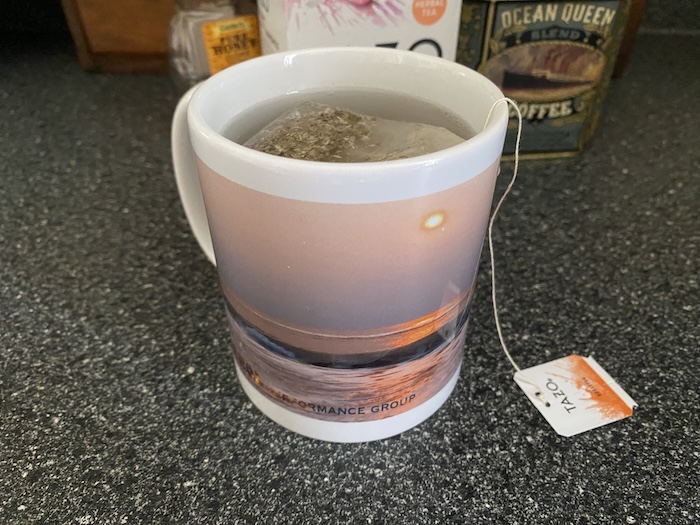
Many people are die-hard stomach sleepers, but you may have heard it’s not the best sleeping position for everyone. While there’s something cozy about hugging the mattress face-first, some experts say it might not be the best choice for your neck, back, and skin.
Here’s what to know about sleeping on your stomach, including who should avoid it and how to help minimize negative effects if you can’t quit the belly snooze.
Note: The content on Sleepopolis is meant to be informative in nature, but it shouldn’t be taken as medical advice, and it shouldn’t take the place of medical advice and supervision from a trained professional. If you feel you may be suffering from any sleep disorder or medical condition, please see your healthcare provider immediately.
Is sleeping on your stomach bad? It depends on who you ask. Generally, stomach sleeping isn’t recommended, but that doesn’t necessarily mean it’s harmful.
Michael Gerling, M.D., American Board-Certified Orthopedic Spine Surgeon and Founder of The Gerling Institute, tells Sleepopolis that the problem isn’t the act of sleeping on your stomach itself but how your spine might be positioned or strained in this position.
Tara Pierce, DC, LAc, and Founder of OC Well Studio agrees. She says, “Healthcare practitioners may advise against sleeping on your stomach due to additional stress it may place on joints of the spine, in particular in the lumbar (lower back) and cervical (neck) regions.” (1)
Of course, there are other important aspects to consider outside of spinal alignment and sleep posture. Different sleep positions can influence how rested you feel in the morning and even impact things like your breathing or muscle tension. Unfortunately, sleeping on your stomach tends to pose the most risk of potentially negative effects.
It can put extra strain on your neck and spine, which may lead to daytime pain. (2) Over time, if you’re a chronic stomach sleeper, this position might play a role in misalignments and muscle strain that affect your overall health. (1)
Instead, many experts suggest side or back sleeping as more supportive options that promote better spinal alignment. If you find yourself waking up on your stomach, don’t panic — just be aware of the reasons some sleep experts advise against it.
According to one survey, about 7 percent of the adult population sleeps on their stomach, while 54 percent sleep on their side and 37 percent sleep on their back. (3)
It’s possible that you’ve been sleeping on your stomach for a while but haven’t noticed any major side effects. However, it’s helpful to understand exactly how sleeping in this position could gradually take a toll on your body.
When you sleep stomach-down, your head often turns from side to side, where it might lie for extended periods. Over time, you might start experiencing neck strain and stiffness as this puts uneven pressure on your muscles and vertebrae. For some people, this constant rotation may result in issues like a herniated disc, chronic neck pain, or annoying numbness. (1)
Pierce says the lumbar spine curve may be placed in an exaggerated ‘sway back’ position, which can irritate spinal joints and nerves and cause pain that spreads across the lower back.
She explains, “In the cervical spine, when laying in a prone position, you’re forced to turn your head to one side or the other to breathe, and this can not only irritate spinal joints in the neck similarly to what was described above for the lumbar spine but may cause muscles in the area to become very tight and painful on the side you are rotated toward.”
Depending on your pillow, mattress, and body position, stomach sleeping can place unnatural curves on your spine, which may lead to back pain.
When you lie on your stomach, your body weight can cause an arch in your lower back, putting stress on your lumbar spine. This misalignment can strain muscles, ligaments, and spinal discs, which support the back, leading to stiffness and pain over time. (1)
Pierce says that laying on your stomach can aggravate already-present symptoms of lower back and neck pain. Plus, if you don’t have enough support while sleeping in this position it can make it harder to maintain a neutral posture.
Dr. Nicole Maholy, DC, CNS, LDN, and wellness coach for WOWMD notes, “Without proper support, lying on your stomach can cause an exaggerated arch in the lower back, putting stress on the lumbar spine, often resulting in discomfort or even chronic back pain.”
Stomach sleeping may trigger or worsen hip pain because of the way it places uneven pressure on the hips and lower body. When you sleep in this position, it often tilts your pelvis forward, causing the spine and hip joints to become misaligned.
This puts strain on the surrounding muscles, ligaments, and tendons, which may cause discomfort in the hips if you don’t have enough support. Additionally, stomach sleepers tend to twist their legs or bend one knee to stabilize themselves, which can increase tension in the hips.
Sleeping on your stomach can strain your lower back and neck and potentially misalign your spine. When you lie face down, your body weight pushes down on your torso, flattening your spine’s natural curvature and forcing it into an awkward angle. (1)
This, in addition to turning your head from side to side throughout the night, may set you up for discomfort and stiffness over time.
If you’re trying to prevent premature facial wrinkles, sleeping facedown may not be the best position. When your face is pressed down onto your pillow or mattress, this may accelerate skin aging effects like wrinkles. (4)
This can happen because extended periods of pressure restrict blood flow to the face and push the skin against underlying structures, potentially creating creases and lines in places where it’s harder for skin to “bounce back” (like your mouth and eyes). (5)
Stomach sleeping isn’t recommended in general, but specific groups should avoid it due to existing health conditions or having an increased risk of complications.
Sleeping on your stomach can worsen existing neck and back pain by further misaligning your spine. This position can force your neck to twist to one side, stressing your cervical spine, and compress your lower back in an unnatural curve. (6)
Proper spinal alignment is good for everyone, especially those already living with neck or back pain. For example, Pierce says people with degenerative disc disease, arthritis, or sciatica may experience more discomfort from stomach sleeping than others.
Sleeping with a neutral spine helps reduce unnecessary pressure so your muscles and ligaments can relax. Back or side sleeping offers better support to help minimize and prevent new pain.
Sleeping on your stomach while pregnant is usually discouraged, but it becomes more physically difficult to do so the further along you are anyway.
In the first trimester, stomach sleeping is typically OK (and easier) because the uterus is still small in size and protected by your pelvis. Many women start to experience discomfort in this sleeping position toward the second trimester and beyond. As the fetus grows, stomach sleeping can compress the uterus and begin to affect blood flow.
By the third trimester, stomach sleeping is strongly discouraged due to increased pressure on the abdomen and potential risks to both mother and baby. Doctors generally recommend side sleeping, especially on the left side, which supports optimal circulation and reduces strain on the growing belly. It can be helpful to get a body pillow or a C-shaped pillow to help support your belly when lying on your side. (7)
Additionally, Gerling says that people with larger bodies, such as larger breasts or enlarged stomachs, pregnant or not, have different alignments of the spine when sleeping on their stomachs. “When laying on the stomach, larger breasts further hyperextend the back, and large abdomens can flex the spine.”
New parents, take note: the safest sleeping position for infants is on their back, which is strongly recommended by pediatric experts.
Infants should also not sleep on their stomachs, as this position carries the highest risk of sudden infant death syndrome (SIDs), which is most prevalent among babies under one year old. (8)
Back-sleeping ensures that an infant’s airway remains unobstructed and promotes better oxygen flow versus stomach or side sleeping. To further enhance safety, a baby’s sleep environment should include a firm mattress, a fitted sheet, and no loose bedding, pillows, “bumpers” around their crib, or toys where they will be sleeping.
If you’re a stomach sleeper and aren’t experiencing pain and stiffness issues, this isn’t meant to worry you. Unless you fall into a higher risk category for related complications, you might choose to continue allowing your body to sleep in this position. Fortunately, there are things you can do to help improve stomach sleeping and help prevent negative effects.
Research shows that a medium-firm mattress is best for preventing back pain in most people. (9) Supportive mattresses help stomach sleepers maintain a more neutral spine alignment, whereas your body tends to sink into a softer mattress, which can exaggerate the arch of your back.
Having a more stable surface helps distribute your body weight more evenly, reducing the likelihood of unnatural spinal curvature. This firmness also helps keep your neck and back straighter, minimizing strain.
Yes, squishy pillows can be dreamy and delightful, but hear us out. Using a thin pillow, or even no pillow at all, can help keep your neck in a more neutral position when sleeping on your stomach.
A thick pillow instead forces your neck to tilt upward, which might increase stress on your cervical spine. (10) Specialized pillows, such as ultra-thin, low-loft pillows, or cervical pillows (pillows made to prevent or reduce neck pain by aligning the cervical spine) with gentle contouring, can provide just enough support without lifting your head too high off your mattress.
Additionally, Gerling recommends stomach sleepers try placing a pillow under the stomach as a way to flex the spine and reduce the effects of sleeping on the stomach. He says, “Flexing the spine typically takes pressure off of the joints in the back of the spine and reduces pressure on nerves in the spinal canal.”
Morning stretches can be a great daily habit for anyone but can be especially therapeutic for stomach sleepers. Stretching when you wake up helps loosen your muscles, improve your mobility and stability, and counteract stiffness caused by a night of spinal misalignment. (11)
For example, try these stretches when you wake up:
Together, stretching and strengthening can help reduce discomfort, enhance mobility, and provide better support for your spine. (12)
Plus, regularly moving your body helps benefit your sleep. Maholy says, “Staying physically active and engaging in exercises that strengthen the core and promote good posture can also help support the spine, making stomach sleeping less problematic,” she explains. (13)
If you’re curious about trying other ways to sleep, you might find that doing so improves problems you didn’t even know you had. Most people favor side sleeping (about 54 percent of adults), which can help keep your spine in alignment and reduce acid reflux and snoring for some. (2)
Then there’s the 37 percent of adults prefer back sleeping, which helps evenly distribute weight and minimize facial contact with your pillow and mattress. Finally, approximately 7 percent of adults say stomach sleeping is their preference, although this position can put extra strain on the neck and back without appropriate support. (1)(2)
Remember, says Pierce, some people are perfectly fine sleeping on their stomachs and have no issues. Sleeping prone is not in and of itself dangerous or problematic. “For people without pain or discomfort stomach sleeping, I don’t recommend they change their sleeping position,” she says. After all, sleeping prone well is far better than sleeping in another more “optimal” position poorly.
Interested in giving these other positions a try? Start by placing a pillow either under your knees when on your back or between your knees when on your side for extra support. You might also like a body pillow to provide more support when side sleeping.
Side sleeping naturally minimizes strain on your neck and back compared to stomach sleeping. Maholy says that side sleeping helps you maintain a neutral spine position, reducing the risk of neck and back pain. This position is also better at keeping your airways open so it’s easier to breathe, which can be helpful for people who snore or have sleep apnea. (14)
People who have acid reflux may also benefit from sleeping on the left side, as this can help prevent stomach acid from going backward into your esophagus and causing burning symptoms. (15)
Gerling adds that sleeping on the side allows one to fine-tune the spinal alignment, flexing or extending the joints into a position of comfort. It’s important to have a supportive bed that will prevent shifting of the bones and excessive pressure on the hips and shoulders.
Lying on your back provides optimal spinal support when combined with the right pillow to maintain the natural curvature of your neck and lower back, Maholy says.
This reduces strain on your neck, shoulders, and lower back. Sleeping this way also helps evenly distribute your weight, which helps to prevent pressure points and keep your muscles more relaxed.
Additionally, Maholy notes that sleeping on your back minimizes how much your face is smushed. This position can also reduce facial compression, which may be a priority for those seeking to minimize premature wrinkles. (5)
Overall, sleeping on your back or side promotes digestive, skin, and musculoskeletal health, reducing the risk of pain and discomfort.
If you’re among the 7 percent of adults who report resting peacefully on their stomachs, the potentially negative effects of stomach sleeping may be news to you. Stomach sleeping isn’t usually the first position many health experts recommend, especially if you have existing pain or a health condition like acid reflux.
But if you tend to snooze best face down and don’t wake up feeling like you were hit by a truck, there may not be a pressing reason to make a change. However, if you’re curious, experimenting with side or back sleeping may leave you pleasantly surprised.
The post Sleeping On Your Stomach – Is It Bad For You? appeared first on Sleepopolis.
]]>